Farhan Faqir
The City Where Alexander the Great Came to Learn
In 326 BCE, Alexander the Great crossed the Hindu Kush mountains with his Macedonian army and arrived at a city called Taxila in what is now northern Pakistan. He came not to conquer — Taxila’s ruler Ambhi had already offered submission — but, according to Greek accounts, to observe and engage with the city’s extraordinary intellectual life. The philosopher-teachers of Taxila, whom Greek writers called Gymnosophists (naked philosophers), debated with Alexander’s entourage on questions of mortality, justice, and the nature of existence.
This encounter between Macedonian Greece and the philosophical traditions of South Asia at Taxila in 326 BCE is a founding moment of the cultural fusion that would define the Gandhara civilization — the remarkable synthesis of Buddhist spirituality and Greek artistic tradition that produced the world’s first human images of the Buddha.
Taxila was, by the time of Alexander’s visit, already ancient. Archaeological evidence dates human settlement at the site to at least the 6th century BCE. The city grew to become one of the great academic centers of the ancient world, comparable in its intellectual reputation to Athens. Students traveled from as far as China, Arabia, and Southeast Asia to study medicine, philosophy, military science, astronomy, and the arts at Taxila. It was, in effect, the world’s first great university.
Taxila as UNESCO World Heritage Site: What This Means for Visitors
Taxila was designated a UNESCO World Heritage Site in 1980. The designation covers three distinct excavated city sites — each representing a different historical period — plus several outlying monasteries and stupas. The total archaeological area is vast, and a thorough visit requires a full day.
The UNESCO designation has brought international conservation attention and funding, but it has also brought a degree of management quality that makes Taxila accessible and interpretable for foreign visitors in ways that some other Pakistani sites are not. Trained English-speaking guides are available, the site museum is well-organized, and the signage is reasonably informative.
The Three Taxilas: Three Cities in One Visit
Bhir Mound: The Oldest City (500 to 200 BCE)
Bhir Mound is the oldest of the three city sites at Taxila, occupied from approximately the 5th to the 2nd century BCE. It represents the period before Alexander’s visit and the era of the Achaemenid Persian Empire’s control of the region. The excavations at Bhir Mound reveal a city of irregular streets and varied construction — less systematically planned than Mohenjo-daro but vibrant with evidence of trade, craft production, and cosmopolitan life. Bhir Mound is the least visually dramatic of the three sites but the most historically significant for understanding Taxila before the Greek influence.
Sirkap: The Greek and Scythian City (2nd century BCE to 2nd century CE)
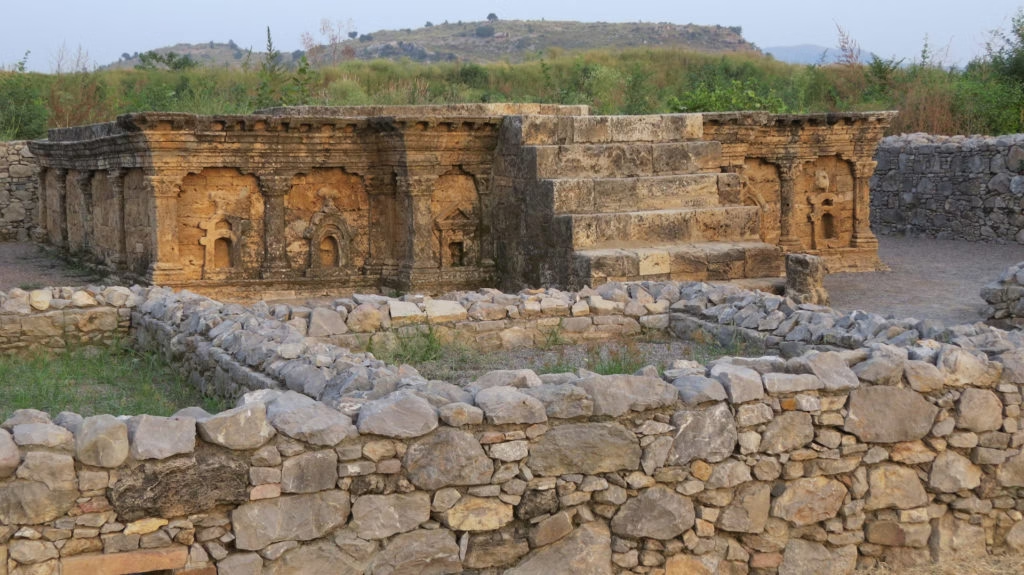
Sirkap, meaning Cut Head in Punjabi (a reference to local legend), is the best-preserved and most visually impressive of the three city sites. Built after the Bactrian Greek rulers took control of Taxila around 180 BCE, Sirkap shows the most direct Greek urban planning influence: streets run on a north-south and east-west grid, and the building materials and decorative elements show clear Hellenistic influence.
The most remarkable structure at Sirkap is the Shrine of the Double-Headed Eagle, a small temple decorated with a frieze showing a double-headed eagle motif that appears in both Hellenistic and South Asian decorative traditions simultaneously. It is a physical image of the cultural fusion that defines the Gandhara civilization.
Sirsukh: The Kushan City (1st to 5th century CE)
Sirsukh, built by the Kushan Empire around the 1st century CE, represents the final major city phase of Taxila. The Kushans were Central Asian nomads who converted to Buddhism and became its greatest patrons. Under Kushan rule, Taxila reached its greatest cultural flowering: Buddhist monasteries multiplied throughout the region, Gandhara Buddhist art reached its finest expression, and the city became a stopping point on the Silk Road trade routes connecting Rome to China.
Jaulian Monastery: The Best-Preserved Buddhist Monastery in Pakistan
Jaulian, approximately 5 km from the main Taxila sites on a hillside overlooking the valley, is the most atmospheric and best-preserved Buddhist monastery in Pakistan. Dating from approximately the 2nd to 5th century CE, the site consists of a large main stupa court surrounded by 28 votive stupas, each originally decorated with stucco sculpture, and a quadrangular monastery complex with individual monk cells arranged around a central courtyard.
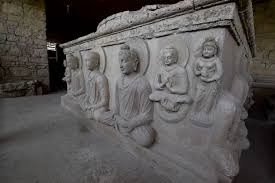
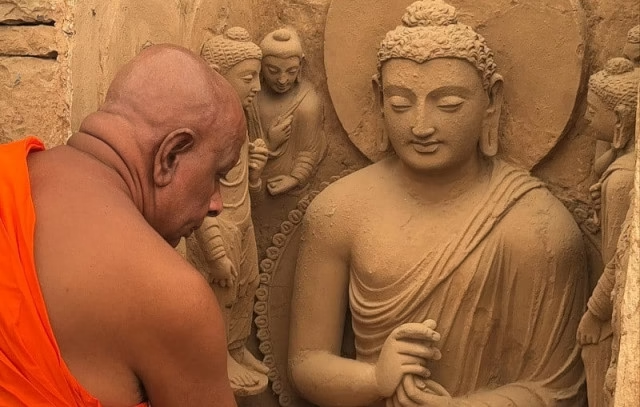
The stucco sculptures that decorated the stupas at Jaulian are among the finest examples of Gandhara art in their original setting. Although many of the finest individual pieces have been removed to museums, enough remains in situ at Jaulian to convey the extraordinary richness of the original decoration. Buddha figures, Bodhisattvas, and narrative scenes from Buddhist literature cover the stupa bases in a continuous visual program that would have been comprehensible to the monks who lived here.
Taxila Museum: The World’s Best Gandhara Art Collection in Its Original Context
The Taxila Museum, located near the site entrance, houses the finest in-context collection of Gandhara Buddhist art in the world. The museum’s galleries contain stone sculptures, stucco reliefs, coins, jewelry, household objects, and scale models of the Taxila sites that provide essential context for understanding what visitors see in the field.
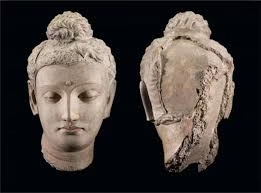
The Gandhara sculpture collection is the centerpiece. These Buddha images from the 1st to 7th century CE show the extraordinary artistic synthesis that occurred when Greek sculptural traditions from Alexander’s campaigns met Buddhist iconography. The result was the first human-form images of the Buddha in history — before Gandhara, the Buddha was represented only symbolically through footprints, parasols, or the Bodhi tree. Gandhara artists, trained in the Greek tradition of depicting idealized human figures, applied this technique to Buddhist spirituality and changed Buddhist art forever.
Taxila as a Day Trip from Islamabad
Taxila is 35 km from Islamabad and is the most accessible major archaeological site in Pakistan for visitors based in the capital. The drive from Islamabad takes approximately 45 minutes to an hour depending on traffic. The Grand Trunk Road (GT Road) connects Islamabad directly to Taxila without requiring a motorway.
A full day at Taxila covers the museum (1 to 1.5 hours), Sirkap and Sirsukh (1.5 to 2 hours), Dharmrajika Stupa (30 minutes), and Jaulian Monastery (1 to 1.5 hours with the hillside walk). An early start from Islamabad by 8 AM allows completion by 4 PM with a lunch break at a local restaurant near the site entrance.
Taxi from Islamabad to Taxila return with waiting time costs approximately PKR 4,000 to 6,000. Careem or InDrive app taxi from Islamabad to Taxila costs approximately PKR 1,500 to 2,000 one way. English-speaking guides at the site entrance charge approximately PKR 1,000 to 2,000 for a 2-hour tour of the main sites and museum.
Practical Visitor Information: Taxila 2026
| Detail | Information |
| Location | Rawalpindi District, Punjab, Pakistan (35 km from Islamabad) |
| Entry fee | Approximately PKR 400 to 600 for foreigners; separate tickets for museum and some sites |
| Opening hours | Typically 8 AM to 6 PM daily; museum may have shorter hours; confirm locally |
| Best time to visit | October to April; October through March for most comfortable temperatures; avoid May to September heat |
| Suggested duration | Full day (6 to 8 hours) to cover major sites and museum thoroughly; half day for museum and Sirkap only |
| Guides | Available at site entrance; PKR 1,000 to 2,000 for 2-hour tour; English-speaking guides usually available |
| Facilities | Basic cafeteria near museum entrance; no restaurant of significant quality on site; bring water |
| Accessibility | Sirkap is walkable on flat ground; Jaulian involves a hillside climb of approximately 20 to 30 minutes |
Frequently Asked Questions: Taxila for Visitors
Taxila is in the same tier as Mohenjo-daro (Pakistan) and the major Angkor Wat complexes (Cambodia) in terms of historical and cultural significance. It is less visually dramatic than Angkor Wat but more intellectually rich in its layering of civilizations. Compared to Indian UNESCO sites like Sanchi or Ajanta, Taxila offers a unique Gandhara art tradition not found elsewhere. For visitors with a serious interest in Buddhist history and Silk Road civilization, Taxila is unmissable.
Yes, with appropriate preparation. The site itself is outdoors with interesting ruins to explore, which older children find engaging. The museum is compact and its sculptures are visually impressive. Younger children may find the long walking aspects tiring. Bringing water, snacks, and sun protection is essential. The site lacks modern visitor amenities beyond a basic cafeteria.
Gandhara art, produced in this region from approximately the 1st to 7th century CE, represents the meeting of Greek sculptural tradition with Buddhist iconography. Gandhara artists were the first in history to depict the Buddha in human form. Their Buddhas have distinctly Greek facial features: wavy hair, folds of fabric resembling classical Greek drapery, and idealized proportions derived from the Greek kouroi tradition. This synthesis spread throughout Asia as Buddhism traveled the Silk Road and forms the artistic foundation of all subsequent Buddhist art in China, Japan, Korea, and Southeast Asia.