Alina Alam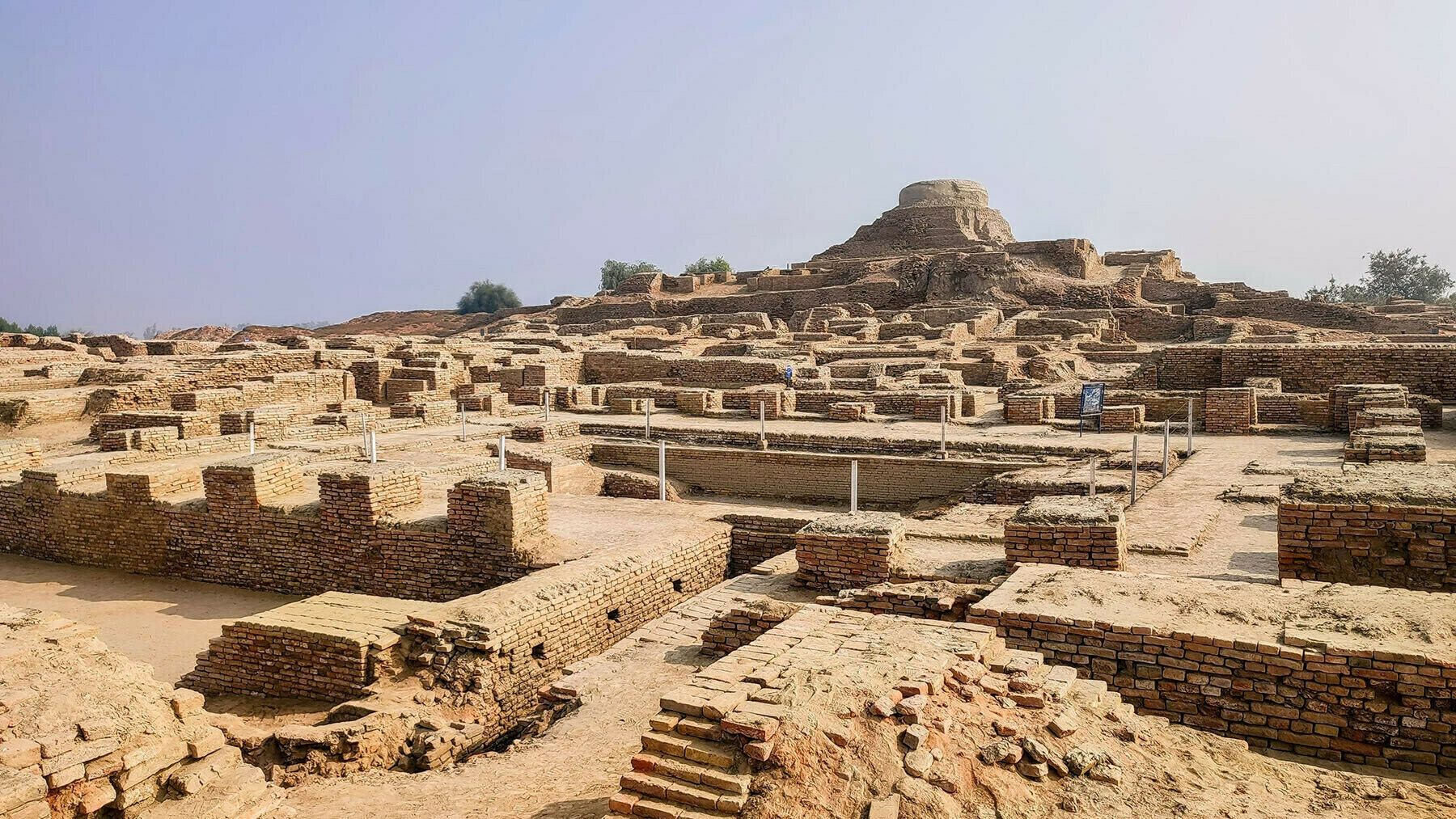
The City That Had Flush Toilets While Rome Was Still Farmland
Around 2500 BCE, while the ancient Egyptians were building the Great Pyramid, a city of approximately 40,000 people was thriving in what is now Pakistan’s Sindh province. Its streets were laid out on a precise grid. Its houses had indoor bathrooms connected to a citywide covered sewer system. Its granaries stored grain with efficient ventilation systems. Its craftworkers produced standardized weights and measures that suggest a sophisticated trading economy.
This city was Mohenjo-daro, meaning Mound of the Dead in Sindhi. It was the largest urban center of the Indus Valley Civilization, the third great civilization of the ancient world alongside Mesopotamia and Egypt, and in many ways the most advanced. Rome would not have public sewer systems for another 2,000 years. London would not have a comprehensive sewage system until the 19th century.
And then, around 1700 BCE, it disappeared. The city was abandoned. The civilization collapsed. For 4,000 years, the mounds at Mohenjo-daro were simply landscape, unremarkable to the villagers who farmed around them. A British-Indian archaeologist named R.D. Banerji rediscovered the site in 1922, and the excavations that followed revealed one of the greatest archaeological finds in human history.
Today Mohenjo-daro is a UNESCO World Heritage Site and one of Pakistan’s most important cultural treasures. It is also, for the foreign traveler willing to make the effort of getting there, one of the most genuinely humbling places on Earth to stand.
The Indus Valley Civilization: The Forgotten Superpower
| Fact | Indus Valley Civilization |
| Period | Approximately 3300 to 1300 BCE (mature phase 2600 to 1900 BCE) |
| Geographic extent | 1.25 million square kilometers — larger than ancient Egypt and Mesopotamia combined |
| Population estimate | Between 1 and 5 million people at peak |
| Known major cities | Mohenjo-daro (Sindh), Harappa (Punjab), Dholavira (India), Rakhigarhi (India) |
| Unique characteristics | Grid street planning, standardized weights, advanced sewage, no evidence of warfare or royal tombs |
| Writing system | The Indus Script — approximately 400 symbols, still undeciphered in 2026 |
| Decline | Approximately 1700 to 1300 BCE — cause still debated (climate change, flooding, migration) |
| Modern location | Sites spread across Pakistan and northwestern India |
The Indus Valley Civilization predates many of history’s most celebrated empires. For context, Pakistan’s north is equally rich in ancient heritage — the 7 Historic Forts of Gilgit-Baltistan reveal how the Karakoram’s ancient kingdoms shaped civilization along the Silk Road thousands of years later.
What You Will Actually See at Mohenjo-daro
The excavated portion of Mohenjo-daro covers approximately 250 acres of the estimated 620-acre city. The site is divided into two main areas: the Citadel (a raised platform on the western side) and the Lower Town (the residential and commercial area to the east).
The Great Bath: One of the World’s Oldest Public Structures
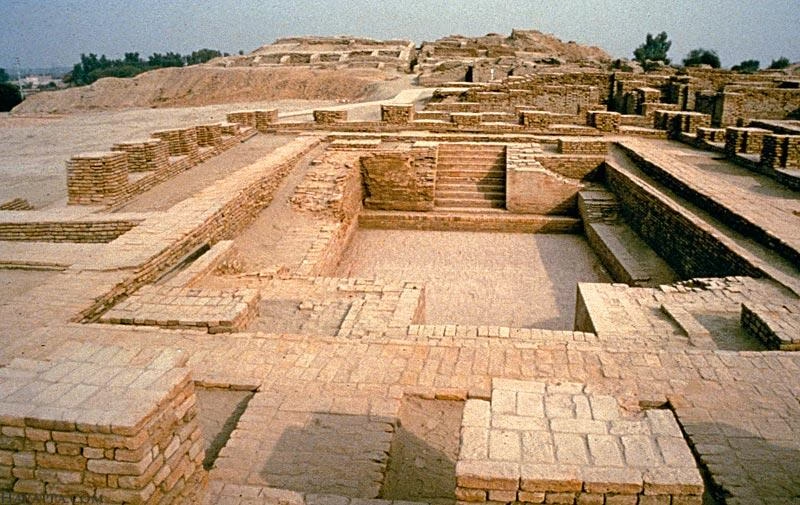
The Great Bath is the architectural centerpiece of Mohenjo-daro and one of the most important structures in ancient archaeology. It is a rectangular pool 12 meters long, 7 meters wide, and 2.4 meters deep, lined with carefully fitted kiln-baked bricks sealed with natural tar to make it watertight. Staircases at each end lead down to the pool floor. Surrounding the pool are changing rooms with individual cells.
The purpose of the Great Bath is debated. The most widely accepted theory, given its central location in what appears to be a ritual or administrative complex, is that it was used for ritual purification rather than recreational bathing. The degree of planning and construction skill required to build a watertight public pool 4,500 years ago is remarkable. The structure still holds water when rain fills it.
For more on Pakistan’s ancient architectural heritage, read about Baltit Fort in Hunza — a 700-year-old fortress that similarly demonstrates the region’s extraordinary building legacy.
The Lower Town: Walking on 5,000-Year-Old Streets
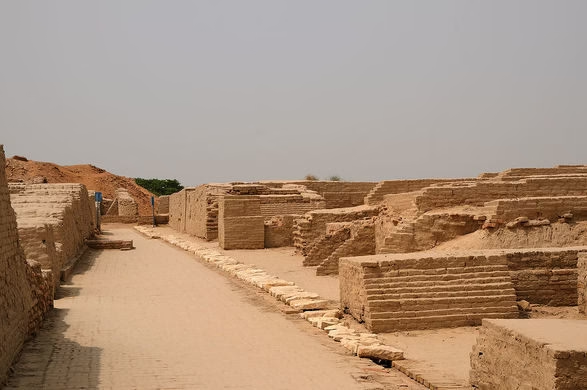
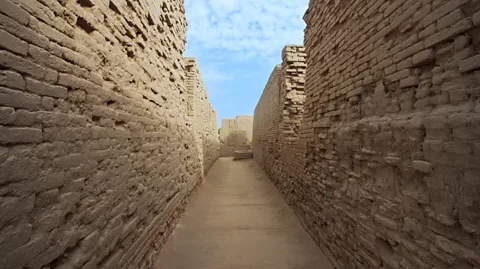
The residential streets of the Lower Town reveal the most extraordinary aspect of Mohenjo-daro: its urban planning was not primitive. Streets run north-south and east-west on a grid plan. Main streets are approximately 9 meters wide — broad enough for carts passing in both directions. Side lanes branch off at right angles. At the corners of intersections, some buildings have rounded corners, suggesting that the city planners anticipated the wear that cart traffic would cause on sharp brick corners.
Houses were built of standardized kiln-baked bricks with a consistent ratio of 1:2:4 (height to width to length). This standardization across all buildings and all cities of the Indus Valley Civilization — from Mohenjo-daro in Sindh to Harappa in Punjab, 600 km away — implies a level of coordinated authority and shared culture that we do not yet fully understand. Most houses faced away from the main streets, opening onto interior courtyards, suggesting that the residents valued privacy and controlled interior environment.
The drainage system visible in the excavated streets is arguably the most remarkable engineering achievement of the ancient city. Every house had a drain connected to a covered brick channel that ran beneath the street. These channels connected to larger drains and eventually to soak pits outside the city boundary. For its time, this represents urban sanitation planning that would not be matched in Europe for 4,000 years.
The Granary and Stupa Mound
The Citadel area contains the ruins of what is interpreted as the city’s granary — a large platform structure with ventilation ducts designed to keep stored grain cool and dry. The scale of the structure suggests it functioned as a central storage and distribution point for the community’s food supply, implying a level of centralized economic administration.
A Buddhist stupa was built on the highest point of the Citadel area approximately 2,000 years after the city’s abandonment, during the Kushana period. This stupa is still visible and has become a landmark orientation point for visitors navigating the site. Its presence above the ancient city layers is a reminder that Mohenjo-daro was not continuously inhabited but was rediscovered and reused by later civilizations who had no knowledge of what lay beneath.
The Dancing Girl: Pakistan’s Most Famous Ancient Artifact
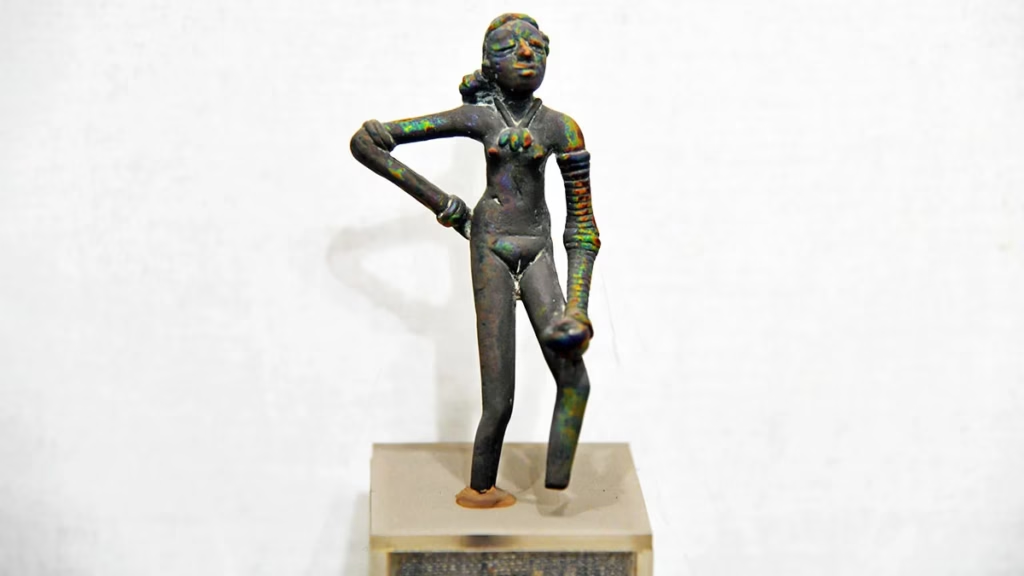
The most celebrated single artifact from Mohenjo-daro is a small bronze statuette, 10.5 cm tall, known as the Dancing Girl. The figure shows a young woman standing in a confident pose with one hand on her hip and one arm weighted with bangles. Her face has a specific, individual quality that sets her apart from the stylized figures of other ancient civilizations.
The Dancing Girl was discovered in 1926 and is now in the National Museum of India in New Delhi, a fact that causes ongoing friction between Pakistani archaeologists and cultural heritage advocates who argue the piece should be repatriated to Pakistan. A copy is displayed at the Mohenjo-daro site museum. The original continues to be one of the most discussed artifacts in debates about colonial-era archaeological removals.
Pakistan’s cultural identity runs deep across all regions. Explore the living traditions that survived into the modern era in our guide to the Culture of Gilgit-Baltistan — festivals, music, and ancient customs still practiced today.
The Mystery of Mohenjo-daro’s End
The Indus Valley Civilization declined and ultimately disappeared over a period of several centuries beginning around 1900 BCE. Mohenjo-daro shows signs of this decline: later construction is of lower quality than earlier building, streets become narrower, and houses are subdivided and overcrowded. By approximately 1700 BCE the city appears to have been largely abandoned.
The cause of this collapse remains one of the great unsolved mysteries of archaeology. Theories include climate change and a prolonged drought that disrupted the agricultural base, the shifting course of the Indus River which flooded and destabilized the city, the arrival of new populations from Central Asia (the Indo-Aryan migration hypothesis), and epidemic disease. No single explanation has achieved consensus. The mystery is part of what makes Mohenjo-daro so compelling: we do not know how this sophisticated civilization ended, and the Indus Script that might tell us remains undeciphered.
Practical Visitor Information: Mohenjo-daro 2026
| Detail | Information |
| Location | Larkana District, Sindh Province, Pakistan |
| Nearest city | Larkana (30 km) or Sukkur (80 km) |
| How to get there by air | Mohenjo-daro Airport (IATA: MJD) has regular flights from Karachi on PIA; flight time approximately 1 hour |
| How to get there by road | From Sukkur: 80 km on Indus Highway; from Larkana: 30 km; road is in good condition |
| Entry fee | Approximately PKR 500 to 1,000 for foreigners; verify locally as fees change |
| Site museum | On-site museum with original artifacts and scale models; included in entry |
| Best time to visit | October to February only; Sindh summers exceed 45 degrees Celsius and the site is not safely visitable May through September |
| Suggested visit duration | Half day minimum (3 to 4 hours); full day ideal including museum |
| Guides | English-speaking guides available at site entrance; PKR 1,000 to 2,000 for a 2-hour tour; strongly recommended |
| Accommodation | Larkana has adequate hotels; Sukkur has better options; no accommodation at the site itself |
Frequently Asked Questions: Mohenjo-daro
For travelers with a serious interest in ancient history, Mohenjo-daro is unmissable. The site is genuinely moving in a way that photographs do not convey. Standing on a 5,000-year-old brick street in a grid-planned city with visible drainage channels and realizing that you are in the remains of a civilization older than ancient Greece is a profound experience. For travelers primarily interested in mountains and scenery, it requires a specific detour to southern Pakistan and may not justify the journey.
No. Sindh summer temperatures regularly exceed 45 degrees Celsius between May and September, and the site has essentially no shade. October through February is the only comfortable and safe window for visiting. Even in winter, morning visits before noon are recommended as afternoon temperatures in Sindh can be warm.
The Indus Script remains undeciphered as of 2026. Approximately 400 distinct signs have been identified on seals, pottery, and tablets found at Indus Valley sites. Multiple academic teams including researchers at the Santa Fe Institute and the Decipherment Institute have applied computational and linguistic methods to the script without achieving a breakthrough. The script may not even encode a spoken language in the way most writing systems do, which complicates decipherment further.
The city of Larkana has several local sites worth exploring. For travelers continuing their Pakistan journey, the 10 Most Extraordinary Cultural Festivals in Pakistan is essential reading to time your visit with living cultural events across the country.
Explore more of Pakistan’s extraordinary heritage on Seasonal Sights:
- Islamabad Travel Guide 2026
- Hunza Valley Travel Guide 2026
- 7 Historic Forts of Gilgit-Baltistan
- Culture of Gilgit-Baltistan
- 10 Most Extraordinary Cultural Festivals in Pakistan