Farhan Faqir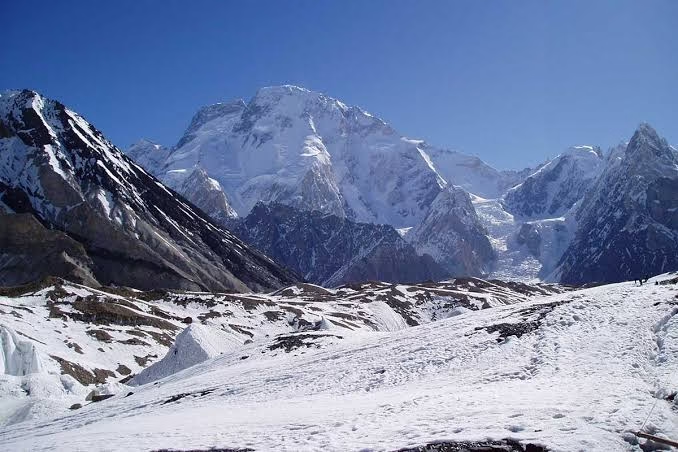
Broad Peak sits just eight kilometers from K2 on the same stretch of the Baltoro Glacier close enough that expedition teams often use it as an acclimatization climb before attempting its far more famous neighbor. For decades it carried a quieter reputation than K2 or Nanga Parbat. That changed on July 30, 2026, when an avalanche killed all ten climbers caught in its path, making it the deadliest single accident in Broad Peak’s history and one of the worst in modern Karakoram mountaineering.
This guide covers everything: the mountain’s stats, its climbing route, expedition logistics, and a fact-checked account of what happened in 2026.
Broad Peak: Key Facts
- Height: 8,047 m / 26,401 ft (12th-highest mountain in the world)
- Local name: Falchan Kangri
- Original survey designation: K3
- Location: Karakoram range, Baltistan, Gilgit-Baltistan, Pakistan on the Pakistan–China border
- First ascent: June 9, 1957, Austrian expedition led by Marcus Schmuck, via the West Face and North Ridge, without supplemental oxygen
- First ascent team: Marcus Schmuck, Fritz Wintersteller, Kurt Diemberger, and Hermann Buhl the same Hermann Buhl who had made the historic solo first ascent of Nanga Parbat four years earlier
- First winter ascent: March 5, 2013, by Maciej Berbeka, Adam Bielecki, Tomasz Kowalski, and Artur Małek
The mountain gets its English name from the unusual breadth of its summit roughly 1.5 kilometers of broad, almost flat ridge at extreme altitude, sometimes compared to the triple-headed Breithorn of the European Alps.
Expedition Summary
| Approach route | Islamabad → Skardu → Askoli → Concordia → Broad Peak Base Camp |
| Duration of expedition | 52 days |
| Average daily walk | 6–7 hours |
| Climbing difficulty | Hard |
| Trekking days (in and out) | 11 |
| Days at base camp and above | 32 |
The Climbing Route
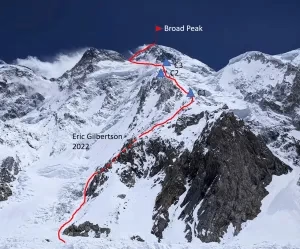
The standard route ascends via the West Spur and North Ridge, gaining more than 3,150 meters from base camp through a mix of scrambling, snow, and rock to the crest of the spur. Above that, the route runs entirely on glacier terrain, with sections of ice wall exceeding 7,500 meters. A well-defined line leads from the col at roughly 7,800 meters to the summit the same high col where much of the 2026 tragedy’s rescue and recovery effort would later take place.
Because the approach shares the same trekking corridor as K2 through Askoli and Concordia, where the Baltoro and Godwin-Austen glaciers meet many expeditions climb Broad Peak first, using it to acclimatize before a K2 attempt.
Camp by Camp
A typical Broad Peak climb is broken into a few key stages above base camp:
- Camp I (~6,000m) reached by climbing a rock gully from base camp
- Camp II (~6,400m) reached by following a large snow face above Camp I
- Camp III (~7,400m) the final high camp, from where climbers make their summit push
The climbing itself isn’t considered extremely steep by 8,000-meter standards, but the remoteness of the Karakoram far from any road, with rescue help hours or days away is what makes the mountain demanding. Most expeditions budget roughly two months in total once travel, acclimatization, and weather delays are factored in, though the exact length shifts depending on a climber’s experience and conditions that season.
Getting to Base Camp
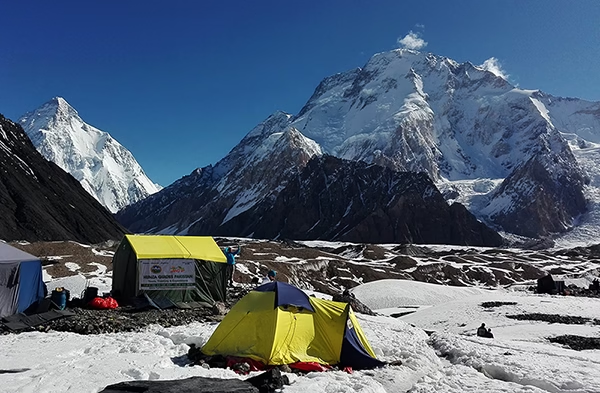
The journey to Broad Peak Base Camp starts in Islamabad, with a short domestic flight (around 45 minutes, weather permitting) to Skardu a route that offers early views of Nanga Parbat, K2, and other Karakoram giants from the air. From Skardu, a jeep track follows the Indus, Shigar, and Braldu Rivers to Askoli, the last inhabited village before the wilderness begins. From there, the trek follows the Baltoro Glacier through Braldu Gorge to Concordia and on to Broad Peak Base Camp itself the same approach used for K2, since the two mountains share this final stretch.
Climbing History Since 1957
Broad Peak’s story didn’t end with its 1957 first ascent. A few milestones worth knowing:
- 1987–88 winter attempt: Polish climber Andrzej Zawada a pioneering figure in high-altitude winter climbing led the first international winter expedition to K2. When that attempt fell short, two of his team members turned their attention to Broad Peak instead, but only reached the Fore Peak rather than the true summit.
- 2005: Denis Urubko and Sergey Samoilov opened a new line up the southwest face, climbing it in fast, lightweight alpine style rather than the traditional siege-style approach with fixed camps.
- 2008: Valery Babanov and Viktor Afanasiev climbed a variation route up Broad Peak’s central pillar on the west face, also in alpine style.
- 2013: The mountain’s first full winter ascent was finally completed by a Polish team Maciej Berbeka, Adam Bielecki, Tomasz Kowalski, and Artur Małek.
These alpine-style ascents matter because they represent a different philosophy of climbing than the fixed-rope, multi-camp expeditions most commercial trips still use today smaller teams, less support, and higher risk in exchange for speed.
What Happened: The July 30, 2026 Avalanche
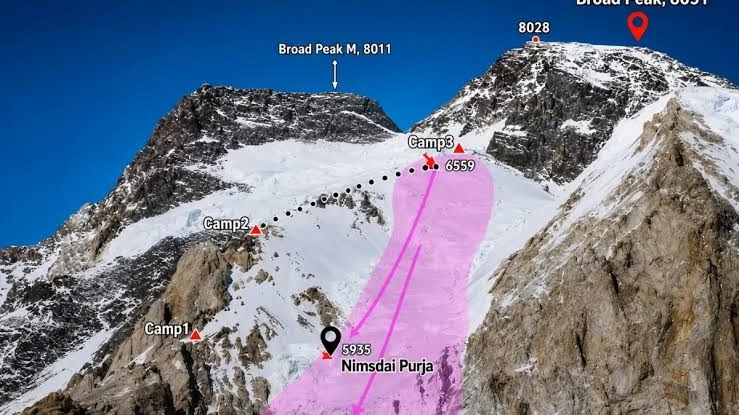
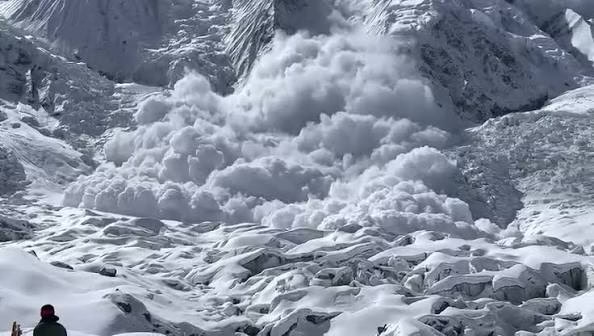
At approximately 9:30 a.m. local time on July 30, 2026, a massive avalanche released on the slope between Camp 2 and Camp 3, at roughly 6,600 meters terrain steep enough (30–45 degrees) to be classic slab-avalanche territory. Ten climbers moving through that section toward a summit push were caught and swept downward, some for over 1,200 vertical meters of debris field.
The ten climbers represented four independent expeditions with no single shared leader, moving on similar timelines during the first clear weather window after a week-long storm had blanketed the Karakoram with heavy snowfall.
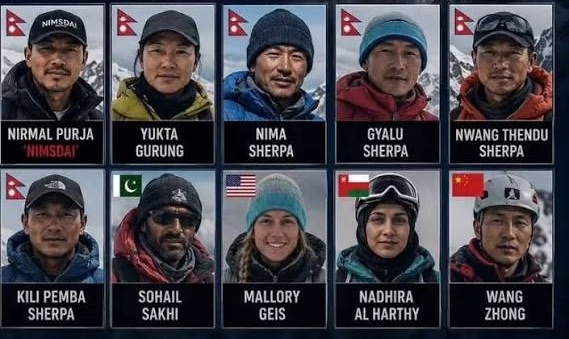
Those who died:
- Nirmal “Nims” Purja (Nimsdai) British-Nepali mountaineer, co-founder of Elite Exped, globally known for his record-setting climb of all fourteen 8,000-meter peaks in under seven months, featured in the Netflix documentary 14 Peaks: Nothing Is Impossible
- Sohail Sakhi Pakistani high-altitude guide from Hunza, an accomplished climber of K2, Nanga Parbat, and both Gasherbrum I and II without supplemental oxygen
- Mallory Geis American climber, attempting her first 8,000-meter peak
- Wang Zhong Chinese mountaineer
- Nadhira Al Harthy Omani climber
- Pur Bahadur “Yukta” Gurung Nepali high-altitude guide
- Nima Sherpa Nepali high-altitude guide
- Kili Pemba “Kilu” Sherpa Nepali guide, part of the team that achieved the first winter ascent of K2 in 2021
- Gyaljen “Gyalu” Sherpa Nepali guide with nearly eight years at Seven Summit Treks, holder of a Guinness World Record for climbing Kangchenjunga three times in one season
- Nawang Thindu Sherpa Nepali guide, 28, the youngest of the group, with five 8,000-meter ascents already to his name
How It Happened
Satellite GPS trackers later showed the scale of the fall Purja’s device recorded a drop of roughly 800 meters, while Al Harthy’s tracker registered a final position more than 1,700 meters below where the avalanche began. Rather than a slab avalanche releasing outward, evidence points to a cornice or serac collapsing from a snowy rib above Camp 3, which then swept climbers off the standard ridge route into the gullies on either side.
The tragedy was compounded by a delayed response: reports reaching Broad Peak Base Camp were significantly delayed after the slide, which pushed back the start of rescue coordination with Pakistan’s search-and-rescue services by hours. Helicopters and ground teams from Camp 1 began aerial and physical searches the next day, but harsh weather and the scale of the debris field made recovery slow. Three climbers Nadhira Al Harthy, Pur Bahadur Gurung, and Mallory Geis were the first formally identified and recovered. By August 1, 2026, all ten deaths were confirmed. Recovery of the remaining climbers continued into early August, with some remains in locations too difficult to access.
Why This Tragedy Stands Out
Broad Peak has recorded fatalities across seven decades from avalanches to falls to exhaustion at altitude but the July 30 disaster is the deadliest single incident in the mountain’s history. Part of what drove global coverage was who was lost: several of the ten were among the most decorated high-altitude workers and climbers alive, not inexperienced amateurs caught out of their depth. The event reignited a broader conversation across the mountaineering community about summit-window decision-making after major snowstorms, rescue-response infrastructure in the Karakoram, and the working conditions of the Nepali and Pakistani guides who make record-setting Western and international climbs possible.
Is Broad Peak Dangerous?
Broad Peak has historically carried a lower fatality rate than K2 or Nanga Parbat, and is sometimes treated as an “easier” acclimatization climb before a K2 attempt a reputation the 2026 avalanche has visibly complicated. Its dangers are typical of any 8,000-meter Karakoram peak: avalanche risk on steep loaded slopes, sudden whiteouts on the long exposed summit ridge, and the general physiological toll of the “death zone” above 8,000 meters, where the body cannot acclimatize and rescue becomes exponentially harder.
Planning a Broad Peak Expedition
Any Broad Peak attempt follows the same approach as K2 flying or driving to Skardu, then trekking through Askoli to Concordia, the spectacular glacial confluence where K2, Broad Peak, and both Gasherbrums are visible from a single point. For context on the wider region and other nearby 8,000-meter peaks, see our guides on K2 Mountain Pakistan and Pakistan’s 5 Highest Mountains. If you’re planning the trek in rather than a summit attempt, our Skardu Travel Guide 2026 covers the logistics of reaching the region, and Kharphocho Fort Skardu is a good first stop before heading toward Askoli.
Frequently Asked Questions
8,047 meters (26,401 feet), making it the 12th-highest mountain in the world.
In the Karakoram range, Baltistan, Gilgit-Baltistan, Pakistan, on the Pakistan–China border, roughly 8 km from K2.
An Austrian expedition led by Marcus Schmuck with Fritz Wintersteller, Kurt Diemberger, and Hermann Buhl reached the summit on June 9, 1957, without supplemental oxygen.
An avalanche on July 30, 2026, struck ten climbers on the route between Camp 2 and Camp 3 at around 6,600 meters. All ten died, including renowned mountaineer Nirmal “Nims” Purja the deadliest single incident in the mountain’s history.
It’s generally considered less technically demanding, which is why many expeditions use it to acclimatize before K2. It is not, however, free of serious objective hazards, as the 2026 avalanche demonstrated.