
 Farhan Faqir
Why Baltit Fort Matters
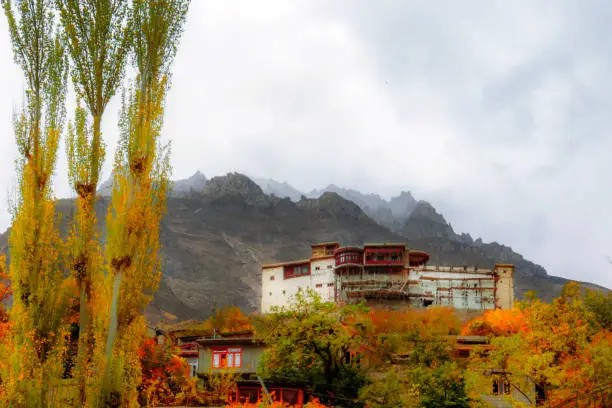
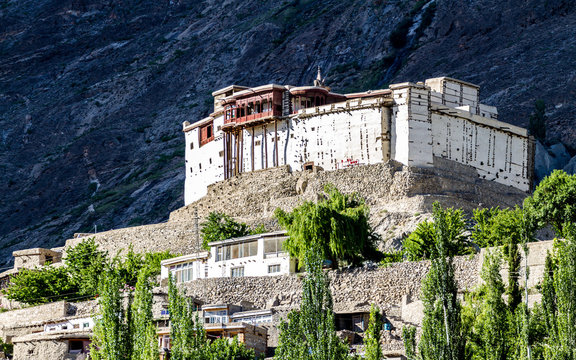
Baltit Fort is the most important pre-modern structure in Gilgit-Baltistan and one of the most historically significant buildings in all of Pakistan. It has been occupied, modified, and extended continuously for approximately 700 years — from the 14th century, when the Mir dynasty of Hunza first established their seat here, until 1945, when the last Mir moved to a new residence. Every era of Hunza’s history is layered into its walls.
More than any other single structure in the region, Baltit Fort is the physical embodiment of Hunza’s position as a Silk Road crossroads. Its architecture — a synthesis of Tibetan masonry in the lower sections, Central Asian design principles in its proportions, and Kashmiri and local techniques in later additions — reads as a direct record of the cultural connections Hunza maintained for centuries. Each layer of construction reflects which trading partners, which neighboring kingdoms, and which craftsmen the Mirs of Hunza were working with at that particular moment in history.
History — 700 Years in One Building
The earliest sections of Baltit Fort are believed to date from the 14th century, though some scholars suggest an even earlier origin. The fort was built by the Mirs of Hunza — the hereditary ruling family whose dynasty controlled the Hunza Valley for approximately 900 years until the accession of the state to Pakistan in 1974. The Mirs received tribute from Silk Road caravans passing through Hunza, maintained diplomatic relations with the Qing Chinese empire (which paid an annual tribute to the Mir to secure safe passage for Chinese traders), and ruled a population whose isolation from the outside world was both their protection and their limitation.
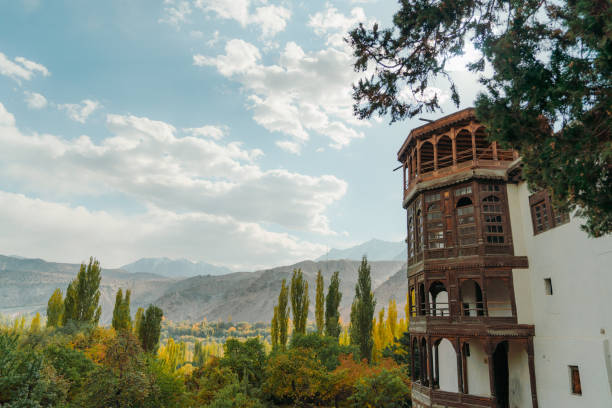
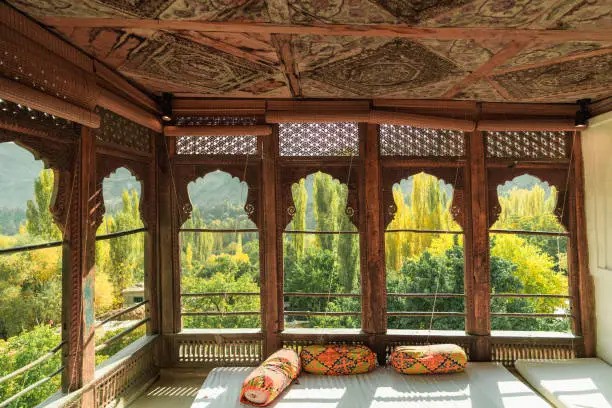
The fort was modified significantly in the early 20th century during the reign of Mir Nazim Khan, who added the large wooden-balconied section that forms the most recognizable element of the current structure. Craftsmen from Kashmir were brought in for this work — the carved wooden window frames, the decorative balcony railings, and some of the plasterwork show clearly Kashmiri influences. This is the section most photographed in tourism materials.
In 1945, the last Mir of Hunza moved to a new, modern residence in Karimabad, and Baltit Fort was vacated. Without maintenance, decades of abandonment took their toll. By the 1980s, the fort was at serious risk of structural collapse.
The Restoration — Seven Years That Saved a Monument
The Baltit Fort restoration project, begun in 1990 and completed in 1996, is widely considered one of the most successful heritage conservation undertakings in Asia. Led by the Aga Khan Trust for Culture with Norwegian government funding, the project employed international conservation architects, Pakistani structural engineers, and — crucially — local Hunzai craftsmen who had to relearn construction techniques that had not been practiced for generations.
The approach was rigorous and documentary. Every part of the fort was analyzed before any intervention. Structural problems were solved with minimally invasive techniques where possible. Materials were sourced or produced to match originals — the specific clay compositions for mud plaster, the wood species for structural beams, the stone types for masonry. Where original elements could be preserved, they were. Where replacement was unavoidable, the replacement was documented to distinguish it from original fabric.
The result was not just the survival of the fort but the recovery of knowledge — techniques of mud plaster, timber-laced masonry, and traditional roofing that had been on the verge of extinction are now practiced by a new generation of Hunzai craftsmen. The project trained over 100 local workers, and the skills they acquired have been applied to other restoration and construction projects throughout the region.
Inside Baltit Fort — Room by Room
The Ground Floor — Storage and Security
The ground floor of Baltit Fort was historically the most utilitarian and the most defensible. Storage rooms for grain, fuel, and supplies — sufficient to sustain the fort through a prolonged siege — occupy much of the ground level. The entrance passage is deliberately narrow and tortuous, designed to slow attackers and prevent direct assault. The jail, where prisoners of state were held, is also on the ground level: a dark, low-ceilinged chamber that communicates the realities of medieval power without editorial comment.
The Middle Floors — Domestic and Administrative Life
The middle floors contain the administrative and residential core of the fort: the main reception hall where the Mir held court and received guests; the residential apartments including the Mir’s private quarters; the zenana (women’s quarters), located in the most private and protected section of the fort and separated from public areas; and a kitchen area with traditional hearths and storage.
The museum displays in these sections include original and period-accurate furniture, weapons (swords, shields, chain mail), ceramics, textiles, and personal objects belonging to the Mir dynasty. Some of the textiles on display — embroidered shawls, woven rugs — are of extraordinary quality and represent the finest achievements of traditional Hunzai material culture.
The Tower and Upper Level — The View
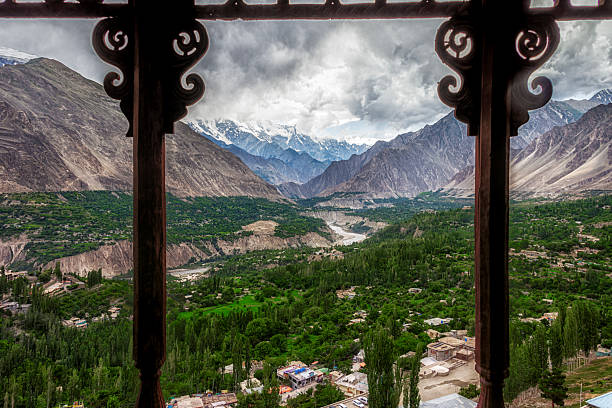
The highest accessible level of Baltit Fort includes the main watchtower — from which the Mir’s guards could observe every approach to the valley — and open terraces. The view from here is one of the finest in Hunza Valley: Karimabad below, the terraced apricot orchards dropping to the valley floor, the Hunza River far below, Rakaposhi to the south, and the glaciated peaks of the Karakoram in every other direction. On a clear day, the view extends into China.
Visiting Baltit Fort — Everything You Need to Know
| Detail | Information |
| Location | Above Karimabad, Hunza Valley; 10-minute walk uphill from bazaar |
| Entry fee | Rs 500 (Pakistani citizens); Rs 1,000 (foreign visitors) |
| Opening hours | 9:00 AM – 5:00 PM daily; CLOSED on Fridays |
| Guided tours | Available at the fort; strongly recommended (Rs 300–500 tip) |
| Photography | Allowed throughout interior and exterior |
| Duration | Allow 1.5–2 hours for a thorough visit |
| Best time | Morning (9–11 AM) before tour groups arrive; golden hour for exterior photography |
| Combined visit | Pair with Altit Fort (5 km south) on the same day |
| Accessibility | Uphill walk from Karimabad bazaar; some interior sections involve low ceilings and uneven floors |
Baltit Fort vs Other Pakistan Heritage Sites
Among Pakistan’s 6 UNESCO World Heritage Sites and dozens of nationally significant monuments, Baltit Fort occupies a unique position. It is not the oldest (Mohenjo-daro, 4,600 years old, predates it by 4,000 years), not the grandest (Lahore Fort’s Mughal architecture is more elaborate), and not the most internationally recognized. But for the combination of physical setting, historical authenticity, quality of preservation, and accessibility of the visitor experience, Baltit Fort is the single best historical site in Gilgit-Baltistan and one of the finest heritage tourism experiences in Pakistan.
Nearby Attractions & Things to Do
Altit Fort (older than Baltit, equally historic)
Eagle’s Nest Viewpoint

3 comments
I think other website proprietors should take this website as an model, very clean and excellent user genial style and design, as well as the content. You are an expert in this topic!
I respect your work, thanks for all the good posts.
My brother suggested I might like this website. He was entirely right. This post actually made my day. You cann’t imagine simply how much time I had spent for this info! Thanks!