Alina Alam
“Is it safe?” is almost always the first question anyone asks before booking a trip to Gilgit-Baltistan and it’s a fair one. The region sits in a seismically active mountain zone, shares borders with disputed territory, and makes international headlines every monsoon season for flooding and landslides. None of that tells the full story.
The short answer: Gilgit-Baltistan is one of the safest regions in Pakistan, with violent crime against tourists close to nonexistent. The real risks here are environmental roads, weather, and altitude not personal security. This guide breaks down exactly what that means for your trip, whether you’re traveling solo, with family, or as part of a group.
The Short Version
| Risk factor | Level | Why |
|---|---|---|
| Crime against tourists | Very low | Locals are protective of visitors; violent crime is rare |
| Terrorism | Low in GB specifically | Most incidents in Pakistan occur far from tourist routes |
| Road conditions | Moderate, seasonal | Mountain roads, landslides, monsoon closures |
| Weather/natural hazards | Moderate, seasonal | Monsoon flooding, GLOFs, winter snow closures |
| Altitude-related illness | Low to moderate | Relevant above ~3,000m (Deosai, Khunjerab, trekking routes) |
| Solo female travel | Generally safe with precautions | Widely reported as comfortable; standard precautions apply |
Current Road Conditions
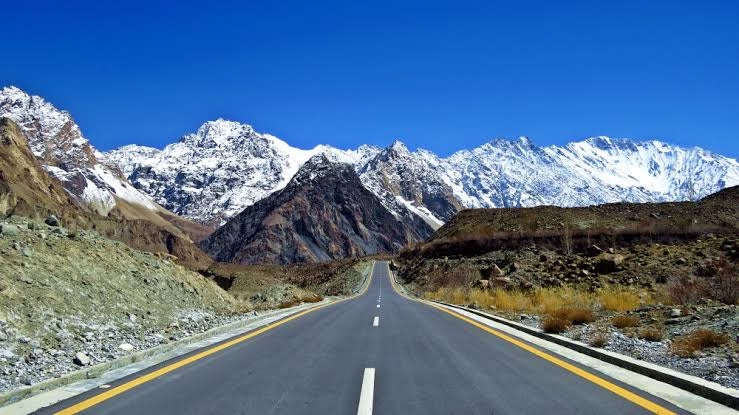
This is the single most important thing to check before you travel, and the one that changes fastest. Gilgit-Baltistan’s roads the Karakoram Highway (KKH), the Gilgit-Skardu Road, Babusar Top, and various side-valley routes are cut through some of the youngest, most geologically active mountains on Earth. Landslides, rockfall, and glacial lake outburst floods (GLOFs) are a normal part of how these roads behave, especially between July and September.
As of mid-August 2026, Pakistan’s National Disaster Management Authority (NDMA) has active flood and landslide alerts covering Hunza, Nagar, Gilgit, Skardu, and several side valleys, following weeks of monsoon disruption along the KKH and the Gilgit-Skardu Road. Closures during these events are typically cleared within hours to a few days by the Frontier Works Organisation, but they can strand vehicles temporarily. We cover the current situation in detail in our Northern Pakistan monsoon flood advisory read that alongside this guide if you’re traveling between June and September.
Outside monsoon season, road conditions are far more predictable. Winter (December–March) brings snow closures at high passes like Babusar and Khunjerab, but the core Hunza-Gilgit-Skardu route generally stays open. Spring and early autumn (April–June, late September–October) are the most stable windows for road travel see our Best Time to Visit Northern Pakistan guide for a full month-by-month breakdown.
Practical takeaway: check the Gilgit-Baltistan Tourism Department’s travel advisories and the NDMA’s alerts in the week before you travel, not months in advance. Conditions on a specific mountain road can look completely different from one week to the next.
Weather
Gilgit-Baltistan’s weather varies dramatically by elevation and season, which matters more here than in most travel destinations because your itinerary likely crosses several climate zones in a single day.
- Summer (June–September): Warm and pleasant in the valleys (Hunza, Skardu), but this is also monsoon season in the lower-elevation approach routes, bringing the flood and landslide risk covered above. High-altitude areas like Deosai and Khunjerab stay cool even in peak summer.
- Autumn (October–November): Clear skies, stable roads, golden foliage widely considered one of the safest and most scenic windows to visit.
- Winter (December–March): Heavy snow closes high passes; lower valleys like Hunza remain accessible but temperatures drop well below freezing at night.
- Spring (April–May): Cherry and apricot blossoms, generally stable weather, though snowmelt can occasionally trigger localized flooding in late spring.
Always check a short-range forecast (3–5 days) rather than a general seasonal outlook, since mountain weather shifts fast and locally.
Areas to Be Cautious Around
Gilgit-Baltistan as a whole is calm, but a few specific categories of caution are worth knowing:
Border and restricted zones. Areas near the Line of Control (LoC) with India and certain zones near the China border require special permits or are off-limits to foreign tourists entirely. Standard tourist routes (Hunza, Skardu, Naltar, Deosai, Fairy Meadows) don’t require this, but if your itinerary includes more remote valleys, check permit requirements with a local tour operator before you go. Our Pakistan visa guide for foreigners covers the broader entry requirements that changed earlier in 2026.
Riverbanks, streams, and bridges during rain. This is the most consistent, practical safety advice from local disaster authorities flash floods in narrow valleys can rise with very little warning. Avoid lingering near water features during or immediately after heavy rain.
Unmarked trekking routes at altitude. Deosai Plateau, Khunjerab Pass, and any trek above roughly 3,000–4,000 meters carry altitude-related risk (see the section below), plus the general hazards of remote terrain weather changes fast and cell coverage disappears. Don’t attempt these solo without local knowledge of the route.
Night driving on mountain roads. Nearly every official advisory in the region repeats this: avoid traveling after dark on mountain roads, especially during or after rain. Visibility, rockfall risk, and the ability to spot road damage all get worse at night.
None of this amounts to Gilgit-Baltistan being a dangerous place to visit it means the risks here are environmental and logistical rather than about crime, and they’re manageable with basic planning.
Solo Travel
Gilgit-Baltistan has a strong, consistent reputation as one of the more comfortable regions in Pakistan for solo travelers, including solo women a claim you don’t hear often about this part of the world, and one that’s borne out repeatedly in traveler reports. Hunza in particular is frequently recommended as a starting point for first-time solo visitors to Pakistan, given its welcoming communities and well-established tourist infrastructure.
That said, “safe” doesn’t mean “identical to traveling in Europe.” A few things solo travelers consistently report as useful:
- Dress modestly loose, conservative clothing (shalwar kameez is widely available and appreciated) reduces unwanted attention significantly.
- Avoid solo night travel, especially on intercity roads.
- Share your live location with someone you trust, and check in daily if you’re heading into remote areas with unreliable signal.
- Carry printed copies of your passport and visa checkpoints along the KKH routinely ask for these, and having copies saves wear on your originals.
- A local SIM card (Zong and SCOM have the best coverage in Gilgit-Baltistan) makes a real difference for staying connected and getting road-status updates.
Solo travelers connecting with other independent travelers to share transport costs is common practice in the region and can also add a layer of safety and company on longer legs.
Family Travel
Gilgit-Baltistan is genuinely family-friendly by regional standards locals are typically warm toward children, and destinations like Hunza and Skardu have enough infrastructure (hotels, restaurants, medical facilities) to handle a family itinerary comfortably. A few adjustments make a real difference:
- Build in more buffer time than you would for a solo or couple’s trip mountain roads and long travel days are harder on kids, and you’ll want slack if a route closes temporarily.
- Altitude matters for children too. If your itinerary includes Deosai or Khunjerab Pass, watch for symptoms of altitude sickness in kids just as you would in adults, and don’t push a fast ascent.
- Pack for temperature swings. Even in summer, evenings at elevation get cold fast layer clothing rather than relying on a single “summer” wardrobe.
- Choose accommodations with reliable heating/cooling in Karimabad, Skardu, or Gilgit rather than more remote homestays if you’re traveling with very young children.
Families traveling with a private driver rather than public transport generally have an easier time managing pace and rest stops, which matters more with kids than with an independent adult itinerary.
Local Guides
Hiring a local guide isn’t strictly necessary for the main Hunza-Karimabad-Skardu circuit, which is well signed and heavily traveled. It becomes genuinely valuable arguably essential the moment your plans include:
- Trekking routes (Fairy Meadows, Deosai off-trail areas, anything approaching K2 or Nanga Parbat base camps)
- Remote or border-adjacent valleys requiring permits or local knowledge of current access rules
- Travel during monsoon season, when road status changes daily and local drivers/guides typically know conditions before any website does
- Homestay-based travel in villages where a local contact smooths logistics considerably
A good local guide or driver does double duty as both a safety resource and a cultural bridge many travelers report that the most memorable parts of a Gilgit-Baltistan trip come directly from conversations and hospitality a guide helps facilitate. For route planning and vetted operator recommendations, see our complete itinerary guide to Northern Pakistan.
Emergency Preparation
Save these before you travel, not after you need them:
- Rescue 1122 Pakistan’s primary emergency service (ambulance, fire, rescue), operational across Gilgit-Baltistan. Dial 1122 from any phone.
- Tourist Police Helpline 1422, specifically for tourists dealing with harassment, theft, scams, disputes, or needing guidance during travel disruptions.
- Police (general) 15
- Edhi Foundation Ambulance 115, a free nationwide ambulance service.
Beyond the numbers themselves:
- Get travel insurance that covers high-altitude activity and medical evacuation if your itinerary includes trekking above 3,000 meters. Standard travel insurance often excludes this check the fine print.
- Carry a basic first-aid kit including altitude sickness medication (consult a doctor before your trip if you’re heading to Deosai, Khunjerab, or higher trekking routes) and any personal medications, since pharmacy access thins out fast outside major towns.
- Download offline maps (Maps.me or Google Maps offline areas) before you leave cell coverage signal drops out entirely in many valleys.
- Register your itinerary with your embassy or consulate if traveling to more remote areas, and share it with someone at home.
- Keep a physical list of emergency contacts and blood type somewhere accessible even if your phone dies a genuinely useful habit anywhere at altitude.
The Bottom Line
Gilgit-Baltistan’s safety profile in 2026 looks a lot like it has for years: low crime, high hospitality, and environmental risk that’s real but manageable with basic precautions and up-to-date information. The headlines about floods and landslides are accurate and worth taking seriously but they describe a region managing a difficult monsoon season, not a place that’s unsafe to visit. Travelers who check current road conditions before departing, build flexibility into their schedule, and use local guides for anything beyond the main touristed circuit consistently report Gilgit-Baltistan as one of the highlights of a Pakistan trip, not a risk they regretted taking.
Frequently Asked Questions
Both are considered among the safest and most tourist-friendly parts of Gilgit-Baltistan. Hunza has slightly more developed tourist infrastructure; Skardu is the gateway to more remote trekking, which carries more altitude and terrain-related risk rather than any difference in crime.
Most of the standard tourist circuit (Hunza, Skardu, Naltar, Fairy Meadows, Deosai) doesn’t require special permits beyond your Pakistan visa, but remote or border-adjacent areas may. Check with a local operator if your itinerary goes beyond the main routes.
Experienced mountain drivers do it, but most visitors especially first-timers are better served by a local driver who knows current road conditions and mountain driving techniques specific to the region.
Road and weather-related disruption (landslides, flooding, altitude sickness) rather than crime. Planning around seasonal conditions and building schedule flexibility addresses most of it.