
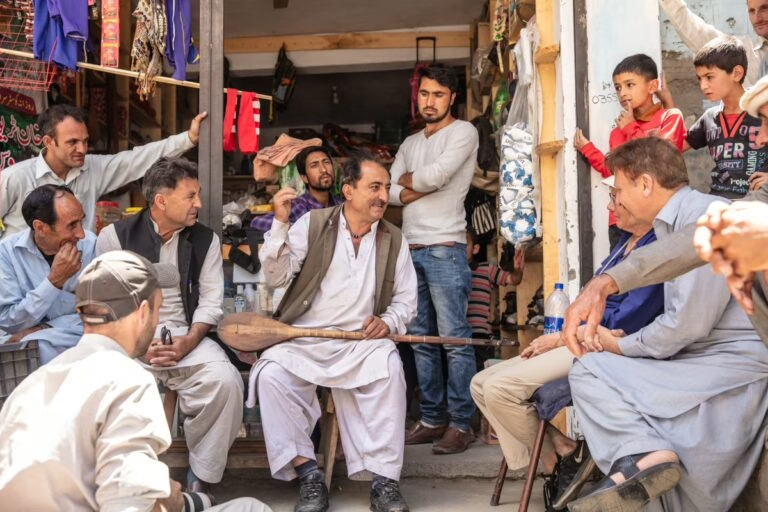
Gilgit-Baltistan, also known as the Northern Areas of Pakistan, is not only famous for its breathtaking valleys and mountains but also for its rich cultural and linguistic diversity. With more than 50 different languages and dialects spoken across its valleys, the region is a living museum of traditions, identities, and histories passed down through generations.
In these mountains, language is more than just communication—it is the essence of cultural identity. Visitors often find that speaking even a few words of the local language brings warmth, hospitality, and heartfelt connections with the people of the region. Below are the main languages of Gilgit-Baltistan, each carrying its unique heritage and charm.
There are many beautiful valleys in the Northern Areas, where people love to spend their holidays due to the pleasant and healthy weather. Gilgit-Baltistan has diversified cultures, tribes, sects, and peoples. Most of the languages in Gilgit-Baltistan are spoken in specific valleys or villages, making them unique to their communities. Local people treat you with more hospitality and love if someone can speak the local language.
Here are the main languages of Gilgit-Baltistan:
Shina Language
Shina is the most widely spoken language in Gilgit-Baltistan, particularly in Gilgit, Diamer, Astore, and parts of Baltistan. It belongs to the Dardic branch of the Indo-Aryan languages and has over 1.1 million speakers across Pakistan and northern India.
Traditionally, Shina was a spoken language with very limited written literature. However, in recent decades, scholars and cultural activists have been working to document Shina poetry, folk tales, and oral history. The language’s folklore is full of mountain legends, seasonal songs, and wisdom passed down from elders.
Shina represents the cultural heartbeat of Gilgit-Baltistan, uniting various valleys under a shared linguistic identity. Its preservation is vital as it links generations to their past.
Balti Language
Balti is a Tibetic language spoken mainly in Skardu, Khaplu, Shigar, and Ghanche. With its roots in classical Tibetan, Balti is why Baltistan is often called “Little Tibet.” Unlike Shina, Balti historically had its own written script derived from Tibetan characters, though today it is usually written in the Perso-Arabic script.
Balti has a rich tradition of poetry, music, and storytelling, blending Buddhist and Islamic cultural influences. Its verses often celebrate the grandeur of mountains, hospitality, and spirituality.
Today, cultural organizations and schools are introducing Balti learning programs, while poets and singers are using digital platforms to promote the language globally. For the people of Baltistan, speaking Balti is not just about communication—it is a symbol of pride and identity. You can learn more about these efforts here.
Burushaski Language
Burushaski, spoken in Hunza, Nagar, and Yasin valleys, is one of the world’s linguistic mysteries. It is a language isolate, meaning it has no known relatives in any other language family.
Burushaski is known for its complex grammar and unique vocabulary, which fascinates linguists worldwide. Locally, it is a treasured symbol of identity for the Burusho people, who use it in songs, riddles, and storytelling traditions.
Despite its beauty, Burushaski faces challenges as younger generations shift toward Urdu and English. Still, the cultural pride attached to Burushaski is strong, and many elders continue to pass it down through oral traditions. Preserving it is not just important for Gilgit-Baltistan but for global linguistic diversity.
Wakhi Language
Wakhi is spoken by the Wakhi people in Upper Hunza (Gojal Valley) and some parts of Ghizer. It belongs to the Eastern Iranian branch of the Indo-European family and is also spoken in Afghanistan, Tajikistan, and China.
Known as the “language of the Pamir mountains,” Wakhi is deeply tied to the high-altitude lifestyle of its speakers, with many expressions describing seasonal migrations, farming, and mountain life. Wakhi culture is enriched with folk dances, songs, and proverbs.
However, Wakhi is vulnerable due to limited formal teaching and dominance of other regional languages. Recently, community-driven projects have started documenting Wakhi songs, stories, and dictionaries, giving hope for its survival.
Khowar Language
Khowar, also called Chitrali, is spoken in the Ghizer District of Gilgit-Baltistan and the neighboring Chitral region of Khyber Pakhtunkhwa. It belongs to the Dardic group of Indo-Aryan languages.
Khowar has a strong tradition of poetry and music, often reflecting themes of love, nature, and mountain life. Historically, it acted as a lingua franca for trade between Chitral and Gilgit.
Although under pressure from Urdu, Khowar still thrives thanks to cultural pride and its presence in festivals, radio programs, and poetry gatherings.
Domaki Language
Domaki, spoken by the Doma community in Hunza and Gilgit, is among the most endangered languages of Gilgit-Baltistan. With only a handful of speakers, mostly elderly, it is at risk of extinction.
Domaki belongs to the Indo-Aryan family and historically served as the language of traveling musicians and craftsmen. Over time, due to social pressures and assimilation into dominant languages like Burushaski and Shina, Domaki has nearly disappeared.
Cultural activists and linguists are documenting what remains of the language to preserve its memory. Saving Domaki would mean honoring the legacy of a unique community that enriched Gilgit-Baltistan’s culture.
Others Languages
Apart from these, smaller communities in Gilgit-Baltistan speak other languages such as Pashto and Urdu. Urdu, being Pakistan’s national language, often serves as a medium of communication between people of different linguistic backgrounds in the region.
Ladakhi and Purgi: These languages are also part of the Tibetic language family, just like Balti. They are spoken by communities in the eastern parts of Baltistan, particularly near the border with Ladakh, India. These languages show the very close historical and cultural links between the people of these high-altitude regions.
Gojri: This language is spoken by the Gujjar community, who are traditionally herders and farmers. You can find Gojri speakers scattered in different valleys of Gilgit-Baltistan. As an Indo-Aryan language, it connects the region to a wider linguistic group in Pakistan and India.
The Role of Urdu, Persian, and Arabic: You can explain that while local languages are used at home and in the community, Urdu is the main language for education, government, and media. You can also mention the historical influence of Persian and Arabic, which have contributed many loan words to the local languages, especially after the spread of Islam. This is a common feature in the languages of the Indo-Pakistani subcontinent.
Conclusion
The linguistic diversity of Gilgit-Baltistan is a living testament to its rich cultural heritage. Each language—whether widely spoken like Shina and Balti, or endangered like Domaki—carries stories, traditions, and histories that form the soul of the region. Preserving these languages is not just about communication; it is about protecting identities and keeping the cultural fabric of Gilgit-Baltistan alive for generations to come.

8 comments
Great line up. We will be linking to this great article on our site. Keep up the good writing.
Nice breakdown
I like what you guys are up also. Such clever work and reporting! Keep up the excellent works guys I’ve incorporated you guys to my blogroll. I think it’ll improve the value of my web site :).
H, this blog was how do i say it… relevant, finally something that helped me. Thanks
Thanks for sharing
We absolutely love your blog and find a lot of your post’s to be what precisely I’m looking for. Does one offer guest writers to write content for you personally? I wouldn’t mind composing a post or elaborating on many of the subjects you write in relation to here. Again, awesome blog!
Whats up very nice website!! Man .. Beautiful .. Wonderful .. I will bookmark your website and take the feeds additionally?KI’m glad to find numerous helpful info here within the publish, we’d like develop extra strategies in this regard, thank you for sharing. . . . . .
Wonderful beat ! I wish to apprentice while you amend your site, how could i subscribe for a blog site? The account aided me a acceptable deal. I had been tiny bit acquainted of this your broadcast provided bright clear concept