
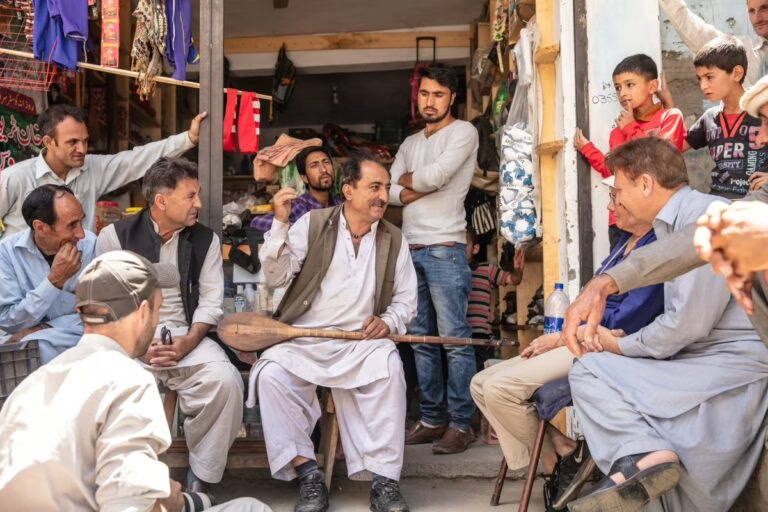
Why Gilgit-Baltistan Is One of the World’s Most Linguistically Dense Regions
Gilgit-Baltistan, Pakistan’s northernmost territory, contains more linguistic diversity per square kilometer than almost anywhere else on Earth. In a region roughly the size of Austria, at least seven distinct languages are actively spoken — and several of them are completely unrelated to each other or to any language family outside the Karakoram. The mountain ranges that divide GB into isolated valleys acted for millennia as natural barriers. Communities evolved independently, their languages preserving ancient features that disappeared elsewhere on the planet thousands of years ago.
For travelers visiting Gilgit-Baltistan, this linguistic richness is not merely academic. It shapes the music, poetry, oral traditions, and the texture of daily interactions you encounter in every valley. Understanding which language is spoken where — and what it means to local identity — transforms a mountain trip into a genuine cultural experience.
The 7 Major Languages at a Glance
| Language | Approx. Speakers | Main Region | Language Family | Unique Fact |
| Shina | 700,000+ | Gilgit, Diamer, Astore | Indo-Aryan (Dardic) | Most widely spoken; tonal features rare in Indo-Aryan |
| Balti | 400,000+ | Skardu, Khaplu, Shigar | Tibetic (Sino-Tibetan) | Preserves 9th-century classical Tibetan; called ‘archaic Tibetan’ |
| Khowar | 250,000+ | Ghizer, parts of Gilgit | Indo-Aryan | Serves as regional lingua franca in Chitral and Ghizer |
| Burushaski | 90,000–130,000 | Hunza, Nagar, Yasin | Language Isolate | No known relatives — anywhere on Earth |
| Wakhi | 20,000–25,000 | Gojal (upper Hunza), Ishkoman | East Iranian | Spoken across 4 countries; Pamir heritage |
| Domari | Small community | Scattered across GB | Indo-Aryan | Language of the Doms — traditional artisan community |
| Urdu | Urban/educated widely | All major towns | Indo-Aryan | National language; used in government and education |
Shina — The Language That Connects the Valleys
Shina is the dominant language of Gilgit-Baltistan by sheer number of speakers. It belongs to the Dardic subgroup of the Indo-Aryan family and is spoken across Gilgit district, Diamer, Astore, and down into Kohistan. Linguists note a remarkable feature of several Shina dialects: they are tonal languages — meaning the pitch at which a syllable is spoken can change its meaning entirely. This feature is extremely rare in the broader Indo-Aryan family and likely developed through long contact with neighboring Tibetan-family languages.
Shina has no standardized written form and historically existed as a purely oral language. Its oral poetry tradition — seasonal songs, wedding compositions, laments, and heroic ballads — has sustained the language through generations. Cultural organizations including the Forum for Language Initiatives (FLI) in Gilgit have been working to document and digitize this oral heritage before elder speakers pass away.
For travelers: in Gilgit city and Diamer district, a simple greeting in Shina — ‘Mach?’ (How are you?) — will earn immediate warmth and often laughter at a foreigner’s attempt.
Balti — The Tibetan Language That Survived in Muslim Pakistan
Balti is linguistically extraordinary. It belongs to the Tibetic branch of Sino-Tibetan — the same family as Tibetan, Dzongkha, and Sherpa — but it preserves features of 9th and 10th century classical Tibetan that modern spoken Tibetan in Tibet has completely lost. Scholars sometimes call it ‘archaic Tibetan in exile.’ When Baltistan converted to Islam in the 14th–15th centuries, the Tibetan script was gradually replaced by Arabic-Persian script, but the spoken language continued with its ancient structure intact.
Today approximately 400,000 people in Skardu, Khaplu, Shigar, and Ghanche speak Balti as their primary language. A smaller community in Kargil, India (on the other side of the Line of Control) also preserves Balti. The Baltistan Festival in Skardu, held annually in autumn, celebrates Balti music, polo, and oral poetry — one of the best opportunities for visitors to hear the language performed.
Burushaski — The Language With No Known Relatives on Earth
Burushaski is the linguistic mystery that has fascinated scholars for more than a century. Spoken by approximately 90,000–130,000 people in Hunza, Nagar, and Yasin valleys, Burushaski is a language isolate — it has no demonstrated genetic relationship to any other language family anywhere on Earth. Not Indo-Aryan, not Tibetic, not Iranian, not Turkic, not Caucasian. It stands entirely alone in the language family tree.
Theories about Burushaski’s origins have ranged from a connection to ancient Caucasian languages, to a link with Basque (Europe’s other famous isolate), to the remnant of a pre-Indo-European language family that once spanned Central and South Asia. None has been conclusively proven. For the traveler in Hunza, Burushaski is the language of the market, the home, and the cultural event. The Burusho people take tremendous pride in their language as a symbol of a unique identity found nowhere else on the planet.
Khowar — The Language of Chitral and Ghizer, Spoken Across Borders
Khowar (also called Chitrali) is the primary language of Chitral district and is also widely spoken in Ghizer district of GB and in parts of upper Gilgit. It has approximately 250,000 speakers and has historically served as a regional lingua franca — a bridge language enabling basic communication between different communities across the Hindu Kush and Karakoram divide. Khowar has a developed literary tradition, with recognized poets celebrated across the region for centuries.
Wakhi — The Language of the Pamirs, Spoken Across Four Countries
Wakhi is spoken in Gojal (upper Hunza) — the area beyond Attabad Lake stretching toward Khunjerab Pass — and in the Ishkoman valley of Ghizer. It belongs to the Eastern Iranian branch, making it a distant relative of Persian and Pashto rather than of the Indo-Aryan languages dominant elsewhere in GB. What makes Wakhi unique geographically is that its speakers are distributed across four countries: Pakistan, China (Xinjiang), Afghanistan (Wakhan Corridor), and Tajikistan (Gorno-Badakhshan). In Pakistan, approximately 20,000–25,000 people speak Wakhi.
Practical Phrases for Travelers
| Phrase | Shina | Balti | Burushaski | Khowar |
| Hello / Greeting | Assalam o Alaikum | Jule | Salaam | Salaam |
| Thank you | Shukriya | Tujey chey | Shukria | Meharbani |
| How are you? | Mach? | Aho? | Ahan? | Suk? |
| Beautiful / Good | Khoobi | Yargo | Nili / Chan | Khoshal |
| Water | Aaloo | Chhu | Hilis | Oop |
| Food / Eat | Kha | Za | Muman | Khour |
Language Preservation — The Race Against Time
Several GB languages face serious pressure. Burushaski, despite its tens of thousands of speakers, has no official status in Pakistan’s educational system. Children in Hunza are educated in Urdu and English — and younger generations are often less fluent in Burushaski than their parents. Wakhi faces even greater pressure from both Urdu and the proximity of Chinese-language media from across the Khunjerab. Linguists from the Endangered Languages Project, SOAS University, and FLI Gilgit have been running active documentation projects — recording oral literature, vocabulary, grammar, and folk stories before elder speakers are gone.
For the traveler, supporting locally produced language materials — phrase books, music recordings, cultural documentaries — directly contributes to preservation. Asking your Hunza guesthouse host to teach you a few Burushaski phrases is not just polite curiosity; it is a small act of cultural respect that local people notice and deeply appreciate.
FAQ: Languages of Gilgit-Baltistan
Q: What language is spoken in Hunza Valley?
The primary language of Hunza Valley is Burushaski — the world-famous language isolate with no known relatives. Wakhi is spoken in upper Hunza (Gojal). Urdu is understood everywhere, and English is spoken in tourist-facing businesses.
Q: Is Burushaski really related to no other language?
Yes — as of 2026, no demonstrated genetic relationship between Burushaski and any other living or historical language family has been scientifically established. It is classified as a language isolate. Theories connecting it to Basque, Caucasian languages, or ancient South Asian languages exist but remain unproven hypotheses.
Q: Can I get by in Gilgit-Baltistan with only English?
In Hunza (Karimabad), Gilgit city, and Skardu, English is sufficient for tourist purposes. In remote valleys and smaller villages, Urdu is far more useful than English. A few words of the local language — Shina in Gilgit, Balti in Skardu, Burushaski in Hunza — will dramatically improve your interactions.
Q: Are GB languages taught in schools?
No — the Pakistani national curriculum teaches only Urdu and English. Local languages are not part of the formal school curriculum in GB, which is one of the primary pressures contributing to language shift among younger generations.

8 comments
Great line up. We will be linking to this great article on our site. Keep up the good writing.
Nice breakdown
I like what you guys are up also. Such clever work and reporting! Keep up the excellent works guys I’ve incorporated you guys to my blogroll. I think it’ll improve the value of my web site :).
H, this blog was how do i say it… relevant, finally something that helped me. Thanks
Thanks for sharing
We absolutely love your blog and find a lot of your post’s to be what precisely I’m looking for. Does one offer guest writers to write content for you personally? I wouldn’t mind composing a post or elaborating on many of the subjects you write in relation to here. Again, awesome blog!
Whats up very nice website!! Man .. Beautiful .. Wonderful .. I will bookmark your website and take the feeds additionally?KI’m glad to find numerous helpful info here within the publish, we’d like develop extra strategies in this regard, thank you for sharing. . . . . .
Wonderful beat ! I wish to apprentice while you amend your site, how could i subscribe for a blog site? The account aided me a acceptable deal. I had been tiny bit acquainted of this your broadcast provided bright clear concept