
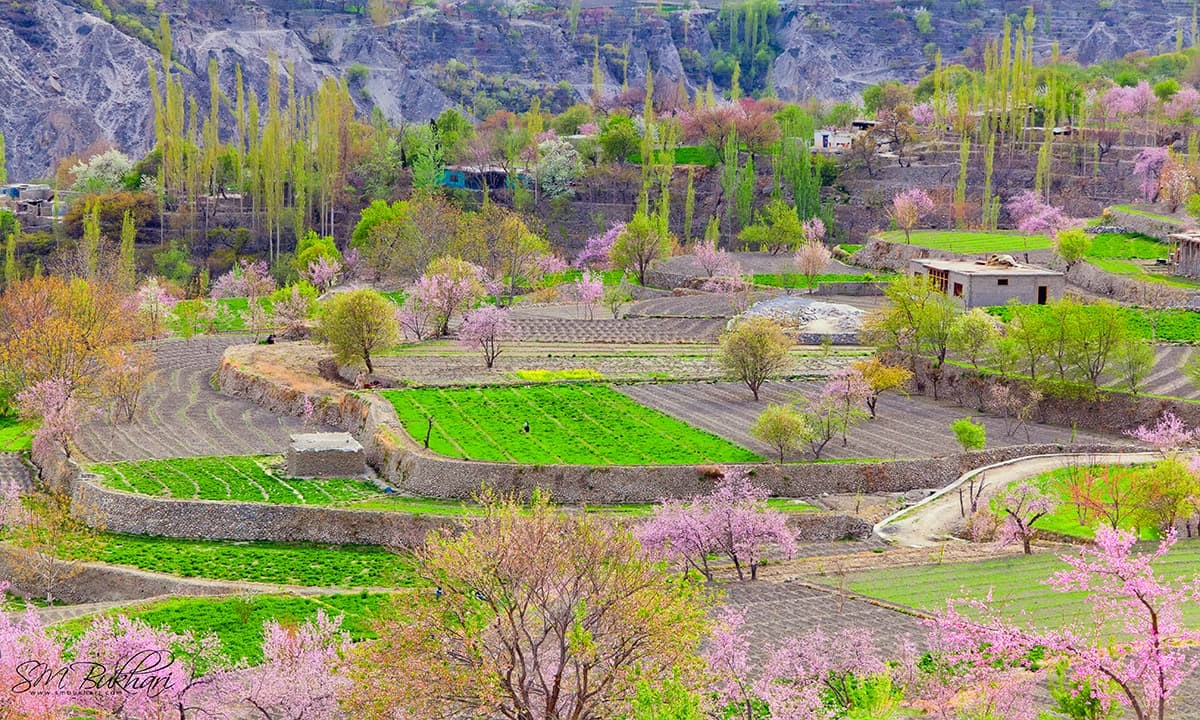
Why Hunza Valley Is Pakistan’s Most Visited Mountain Destination
Hunza Valley — the high-altitude valley carved by the Hunza River through the central Karakoram — has attracted travelers, explorers, botanists, climbers, and food writers since the 19th century British surveys of the northern frontier. The combination of extraordinary mountain scenery, ancient forts, a unique cultural identity, a renowned food tradition, and the famous warmth of the Burusho people creates a travel experience that has earned Hunza Valley an international reputation disproportionate to its population of approximately 100,000.
Hunza is the single most visited destination in Gilgit-Baltistan and one of Pakistan’s top five tourist attractions by visitor numbers. Yet compared to comparable mountain destinations in Nepal, Bhutan, or the Chinese Himalayas, it remains dramatically under-visited by international tourists — which is both a practical advantage for those who go and a window that is rapidly closing as Pakistan’s tourism sector grows.
Hunza Valley Quick Reference
| Detail | Information |
| Main town | Karimabad (also called Baltit) — the tourist hub at 2,438m |
| Elevation range | 1,900m (river valley floor) to 2,800m+ (upper villages) |
| Distance from Gilgit | ~100 km (1.5–2 hours by KKH) |
| Distance from Islamabad | ~640 km (10–12 hours by road; 1 hour flight to Gilgit then drive) |
| Key language | Burushaski — with Urdu widely understood; some English in tourist areas |
| Religion | Predominantly Ismaili Islam (followers of Aga Khan) |
| Best season | Late March–October; cherry blossoms peak March–April; autumn Oct is exceptional |
| ATMs | Available in Karimabad (limited — carry extra cash) |
| Mobile network | Decent 3G/4G in Karimabad; patchy above the main town |
Month-by-Month Visitor Guide — When to Come and Why
| Month | Season | Key Attraction | Crowd Level | Temperature (Karimabad) |
| March | Late winter / early spring | First almond blossoms; quiet valley; local life unaffected by tourists | Very low | 5–12°C day; near-freezing nights |
| April | Cherry blossom PEAK | Pink and white orchards; snow peaks backdrop; most photographed season | Low–Medium (growing fast) | 10–18°C day; cool nights |
| May | Late spring | Green terraces; clear skies; warm enough for light trekking | Medium | 15–22°C day; mild nights |
| June | Early summer | All attractions accessible; Ginani harvest festival (Jun 21) | Medium | 20–28°C day |
| July–August | Peak summer | Warmest weather; domestic tourism peak; Attabad boat rides; all treks open | High | 22–30°C day; warm nights |
| September | Early autumn | Changing light; thinner crowds; excellent photography; harvest season | Medium | 16–24°C day |
| October | Autumn PEAK | Golden poplars and apricot trees; crystal-clear air; dramatic light | Medium–High (international peak) | 10–18°C day; cold nights |
| November | Late autumn | Very quiet; cold nights; golden remnant color; local life returns to normal | Very low | 2–10°C day; frost at night |
| December–February | Winter | Snow possible; KKH open but icy; off-season prices; very few tourists | Minimal | Below 0°C nights |
Top Attractions in Hunza Valley
Baltit Fort — 700 Years of Silk Road History
Baltit Fort, perched on a rocky spur directly above Karimabad, is the most important historical monument in Hunza. Built approximately 700 years ago and continuously modified through the 20th century, it served as the residence of the Mir (hereditary ruler) of Hunza until the 1940s. The three-story structure of timber, stone, and mud brick shows heavy Tibetan architectural influence — visible in the wooden balconies, the decorative wooden screens, and the spatial layout of rooms. The fort was restored in the 1990s by the Aga Khan Trust for Culture and is now open as a museum. Guided tours (required; included in the entry fee) take approximately 45 minutes. The roof terrace views over Karimabad, the valley, and toward Rakaposhi and Ultar Peak are among the finest vantage points in Hunza.
Altit Fort — The Older, Less-Crowded Alternative
Altit Fort, 5 km from Baltit in Altit village, predates Baltit by several centuries — possibly 900 years old — making it among the oldest continuously inhabited structures in the Karakoram. It sits on a cliff edge above the Hunza River gorge with vertiginous drops directly below its foundations. The surrounding old village of Altit has been extensively restored by AKTC and offers an authentic view of traditional Hunza architecture that the more heavily touristed Karimabad bazaar cannot provide. Visit in the morning before tour groups arrive.
Eagle’s Nest Viewpoint — The Best Panoramic View in Hunza
The Eagle’s Nest viewpoint above Duikar village, at approximately 2,900 meters, is the quintessential Hunza Valley panorama: Rakaposhi (7,788m) to the south, Ultar Sar (7,388m) directly above Karimabad, the silver ribbon of the Hunza River threading the valley below, the KKH visible as a thin line on the valley walls, and ranges extending in every direction. Sunset from Eagle’s Nest — when the peaks turn pink, then gold, then alpenglow red — is one of the most photographed scenes in Pakistan. The viewpoint is accessible by jeep from Karimabad in 20–30 minutes, or by a 2-hour hike.
Attabad Lake — A Turquoise Miracle
Attabad Lake, 35 km beyond Karimabad on the KKH, was created by a catastrophic landslide in January 2010 that killed 20 people, displaced 6,000 more, and blocked the Hunza River for five years. The backed-up water created a 21-km lake of extraordinary turquoise — the color produced by rock flour (glacially ground mineral particles) suspended in the water. Five CPEC tunnels now bypass the submerged section of the original KKH. Boat rides on the lake are available from both ends. Best visited in morning light when the turquoise is most intense.
Where to Stay in Hunza (Karimabad)
| Property | Category | Price Range (2026) | Best For |
| Serena Hotel Karimabad | Luxury | PKR 22,000–45,000/night | Best hotel in Hunza; mountain views; full international facilities |
| Hunza Darbar Hotel | Mid-range | PKR 7,000–14,000/night | Good central location; reliable; comfortable |
| Old Hunza Inn | Budget-Mid | PKR 3,500–7,000/night | Family-run; authentic local food; traditional atmosphere |
| Rakaposhi View Hotel | Mid-range | PKR 5,000–10,000/night | Views of Rakaposhi; central Karimabad location |
| Mountain View Guesthouse | Budget | PKR 2,000–4,000/night | Backpacker-friendly; rooftop views; good value |
| Homestays in Altit/Ganish villages | Budget authentic | PKR 1,500–3,000/night | Deepest cultural immersion; traditional food; advance arrangement needed |
