
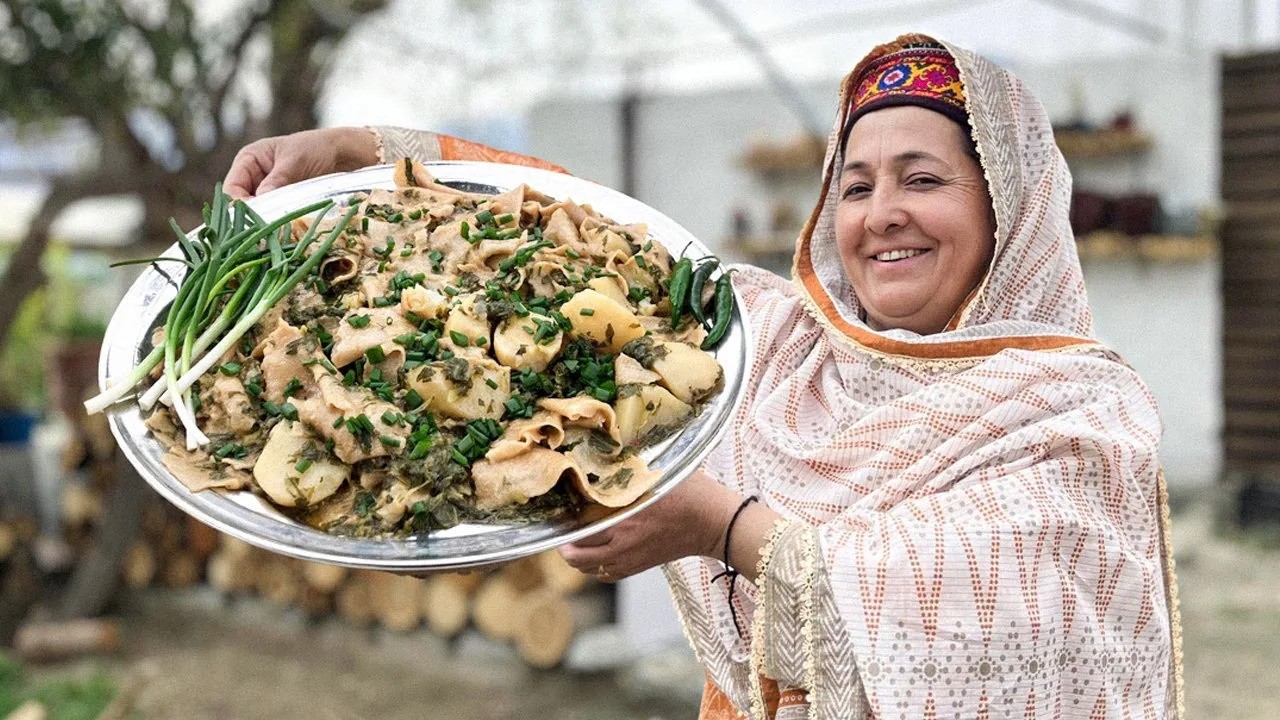
What is Hoi Lo Garma? — Name, Meaning, and Cultural Roots
Hoi Lo Garma is a traditional Hunza Valley dish whose name in Burushaski (the local language of Hunza) translates approximately as ‘warm nourishment’ or ‘warmth and sustenance’ — ‘Hoi’ referencing warmth or comfort, ‘Lo Garma’ referencing food that nourishes and sustains. The dish is a thick, warming combination of barley or wheat dough pieces, leafy green vegetables (traditionally dried or fresh), and rich local butter or ghee — cooked together into a hearty, filling soup-stew that sits somewhere between pasta in broth and a grain porridge.
Hoi Lo Garma is primarily a cold-weather food — eaten during the deep Hunza winters when the valley is snowbound, fresh vegetables are unavailable, and the temperature drops far below zero. In those months, a bowl of Hoi Lo Garma served steaming hot in a clay or metal bowl provides exactly the caloric density and warmth the body needs at 2,400+ meters elevation. It is comfort food in the most literal, physical sense of that phrase.


The Key Ingredients — What Goes into Hoi Lo Garma
| Ingredient | Role in the Dish | Traditional Source | Modern Substitute |
| Barley | Primary carbohydrate base — handmade ribbons or small dumplings | Locally grown in Hunza valley fields | Barley flour from health food stores |
| Wheat flour | Dough for noodle/dumpling pieces | Locally milled | Whole wheat atta |
| Leafy greens (akhrot patta or sag) | Flavor, nutrition, color | Dried from summer harvest; fresh in season | Spinach, chard, or fenugreek leaves |
| Dri butter (yak butter) | Richness, fat, traditional flavor | From locally raised female yaks (dri) | Unsalted butter or ghee |
| Salt | Seasoning | Rock salt from local sources | Sea salt |
| Water or light broth | Cooking medium | Spring or glacial meltwater | Vegetable or light meat broth |
How Hoi Lo Garma Is Made — Traditional Step-by-Step Method
Step 1 — Make the dough: Combine barley flour (or a barley-wheat blend) with salt and enough water to form a firm, smooth dough. Knead for 5 minutes. Rest 15 minutes.
Step 2 — Prepare the greens: If using dried greens, soak in warm water for 20–30 minutes until softened, then roughly chop. If using fresh greens (spinach works perfectly), wash and chop roughly.
Step 3 — Shape the dough pieces: Pull or roll small pieces of dough — either rough torn pieces (rustic), flat ribbons (noodle-style), or small dumplings (ping-pong ball size, slightly flattened). These will cook directly in the broth.
Step 4 — Cook together: Bring water or light broth to a rolling boil in a heavy pot. Add the dough pieces and cook 8–12 minutes until almost tender. Add the greens and cook another 5 minutes. Season with salt.
Step 5 — Finish with butter: Remove from heat. Add a generous knob of dri butter (or ghee) and stir until melted throughout. Serve immediately in deep bowls — the dish thickens rapidly as it cools. Eat with Diram Fitti or simple flatbread on the side.
The Cultural Context — When and Why Hoi Lo Garma Is Made
Hoi Lo Garma is not a restaurant dish — it is a home food, made by families for themselves during the months when the high passes are closed and Hunza is cut off from the rest of the world by snow. In the past, before the Karakoram Highway provided year-round connectivity (and even today during winter closures), Hunza communities relied entirely on preserved and stored food from summer — dried apricots, walnuts, dried mulberries, stored grain, and dried vegetables.
Hoi Lo Garma represents the creative use of those stored ingredients. The combination of grain, dried greens, and butter is not a recipe designed by a chef — it is the practical wisdom of mountain communities who understood exactly which nutrients they needed through winter and built a dish that provided them. The warmth of the butter and the substance of the grain are not aesthetic choices; they are physiological necessities at altitude in winter.
How to Experience Hoi Lo Garma as a Traveler
Hoi Lo Garma will not appear on any restaurant menu in Karimabad. It is genuinely a home food. The best — and essentially only — way to experience it authentically is through a homestay arrangement in one of Hunza’s older villages (Altit, Ganish, or villages of upper Hunza), or by specifically requesting it from a family guesthouse with at least 24 hours advance notice. The dish requires slow preparation and specific ingredients; a host cannot make it on a moment’s notice for a tourist.
If you are planning to stay at a family guesthouse in Hunza for several days — which is the recommended approach for cultural immersion — mention Hoi Lo Garma in your first conversation with your host. They will either offer to prepare it or tell you honestly that they don’t make it. Either way, the conversation will open a window into Hunza food culture that a restaurant visit cannot.
You Might Also Love:
🔥 Chapshuro – The Hunza Meat Pie
A crispy, pan-seared flatbread stuffed with seasoned meat. Think of it as Hunza’s answer to pizza meets pasty — bold, filling, and deeply satisfying. Read the full recipe →
🥣 Harisa – The Hearty Winter Porridge
A warm, slow-cooked blend of grains and meat, perfect for cold mornings in the mountains. Comfort food at its finest. Learn how to make Harisa →

1 comment
I am pleased that I observed this site, precisely the right info that I was looking for! .