
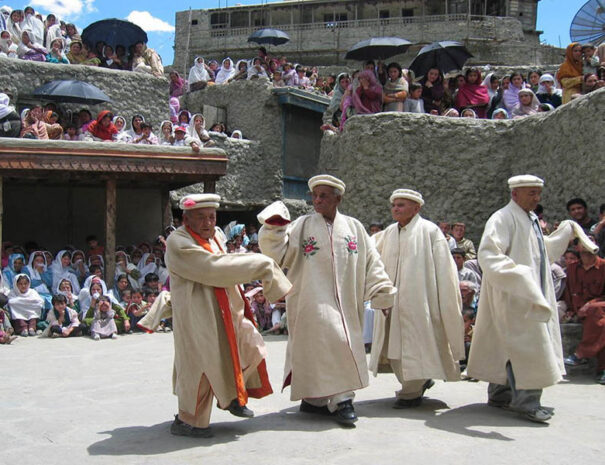
A Culture Shaped by Mountain Kingdoms, Silk Roads, and Isolated Valleys
Gilgit-Baltistan’s culture is not a single tradition — it is a mosaic of at least a dozen distinct cultural systems shaped by geography, religion, trade routes, and centuries of independent kingdoms. The Karakoram and Hindukush ranges divided the region into isolated valleys, each developing its own language, music, dress, social customs, and seasonal ceremonies. The ancient Silk Road brought Persian, Chinese, Central Asian, and South Asian influences into contact with indigenous Dardic and Tibetan traditions. The result is a cultural richness that few regions anywhere in the world can match.
For American and international travelers, GB’s living culture is one of the primary reasons to make the long journey beyond the scenery. The hospitality of the Hunza people, the traditional polo matches of Shandur, the Hunza embroidered caps worn by craftswomen, the harvest festivals of Baltistan — these cultural experiences are as compelling as K2 or the Karakoram Highway itself. This guide covers the key festivals, traditional clothing, music, and hospitality customs that define daily and ceremonial life across the region.


The Cultural Groups of Gilgit-Baltistan
| Community | Primary Religion | Language | Region | Known For |
| Hunzakuts (Burusho) | Ismaili Islam | Burushaski | Hunza, Nagar | Longevity culture, education, embroidery, progressive values |
| Baltis | Shia Islam | Balti | Skardu, Khaplu, Shigar | Polo, Tibetan-heritage festivals, Mayfung, apricot culture |
| Shins / Dards | Sunni Islam | Shina | Gilgit, Diamer, Astore | Oral poetry, Shandur polo, traditional music |
| Khowar speakers | Sunni & Ismaili | Khowar | Ghizer, Chitral border | Ancient festivals, woodcraft, Takhum Rezi |
| Wakhi | Ismaili Islam | Wakhi | Gojal (upper Hunza), Ishkoman | Pamiri traditions, yak culture, cross-border heritage |
The Major Festivals — When and Where to See Them
Shandur Polo Festival — The Roof of the World’s Greatest Match
The Shandur Polo Festival, held each July on Shandur Pass at 3,700 meters above sea level, is arguably Pakistan’s most spectacular cultural event. The festival pits traditional teams from Gilgit against Chitral in a three-day tournament on what is promoted as the world’s highest polo ground. The match is played by traditional rules — no strict time limits, fewer restrictions, and a physical intensity that modern league polo rarely approaches.
Thousands of spectators camp on the plateau under the open sky, surrounded by snow-capped peaks. Traditional music and dance performances accompany the matches throughout the day. At night, bonfires and communal singing continue into the early hours. The festival is the cultural centerpiece of GB’s tourism calendar and requires advance planning — accommodation at Shandur itself is camping only, and the nearest guesthouses are hours away in Mastuj or Gupis.
| Detail | Information |
| Location | Shandur Pass, between Gilgit-Baltistan and Chitral |
| Altitude | 3,700 meters (12,139 feet) — world’s highest polo ground |
| Timing | Annually, July 7–9 (verify dates each year) |
| Duration | 3 days of matches plus cultural events |
| Teams | Traditional Gilgit vs Chitral — free-style polo rules |
| Accommodation | Camping on-site; guesthouses in Mastuj (Chitral side) and Gupis (GB side) |
| How to get there | By road from Gilgit (~7 hours) or Chitral (~6 hours); road condition varies |


Takhum Rezi — The Ancient Spring Sowing Festival of Ghizer
Celebrated in the Ghizer district of GB, Takhum Rezi (also called Bo or Bee Ganik in some valleys) marks the arrival of spring and the beginning of the sowing season. This ancient festival combines agricultural rituals with community celebration. Key traditions include torch-bearing processions that symbolically purify the fields and the community, traditional dances performed in village clearings, and horse races. The seed-scattering ceremony — where handfuls of grain seed are scattered across newly thawed fields while prayers for a bountiful harvest are offered — is the spiritual heart of the festival.
Takhum Rezi is not a widely publicized tourist event — it remains a genuine community observance. Travelers who are in Ghizer in early spring and who show respectful interest are often welcome to observe. Ask at your guesthouse for current timing as it varies by valley and year.


Ginani — The Summer Solstice Harvest Festival of Hunza
The Ginani Festival is celebrated around June 21st in the Hunza region, marking the summer solstice and the beginning of the wheat and barley harvest season. It is a thanksgiving festival combining prayers for agricultural prosperity with communal music, folk dancing, and feasting on freshly harvested produce. The festival has ancient roots predating Islam in the region — its solstice timing reflects agricultural calendar traditions that stretch back thousands of years in high-altitude farming communities.
For the traveler, Ginani offers a window into a Hunza that exists outside of tourist infrastructure — a community gathering centered on gratitude, seasonal cycles, and shared abundance. Local guesthouses in Karimabad can advise on current Ginani events and whether outside visitors are welcome in particular village celebrations.


Mayfung — The Winter Solstice Festival of Baltistan
Mayfung is celebrated around December 21st in Baltistan — the winter solstice and the Balti New Year. Its roots are in pre-Islamic Tibetan Buddhist traditions that marked the triumph of light over the long darkness of the Karakoram winter. The festival involves lighting torches and lanterns, communal fire dances, and feasting — with the fire symbolizing the return of the sun’s strength after the shortest day of the year.
Mayfung is one of the least visited but most atmospheric festivals in GB. The Skardu Basin in late December, when the mountains are white with fresh snow and the valley is quiet with the off-season calm, is a dramatically different experience from the summer tourist rush. The festival’s warmth — literal and social — in this cold, stark landscape is memorable.


Nasalo — The Communal Meat Preservation Tradition of Baltistan
Nasalo is a winter tradition unique to Baltistan — typically in late November or December — that involves the communal slaughtering and preservation of meat for the long snowbound months ahead. Villagers gather around bonfires, stories are shared, and meat is processed and dried for winter storage. The dried sausages produced through Nasalo — called warki or ghittey — are a direct product of this tradition and appear in Balti cooking throughout the winter season.
Nasalo is not a festival in the tourist sense but a practical community tradition with deep social meaning. It represents the cooperative food security system that sustained Baltistan through isolated mountain winters before modern supply chains. Travelers staying in Skardu in November who build relationships with local families may be invited to participate.

Traditional Dress — Reading Cultural Identity Through Clothing
Traditional dress in Gilgit-Baltistan varies significantly by valley, community, and religion, but several elements are widespread and immediately recognizable to those who know what to look for. The Pakol — the round, flat-topped woolen cap worn by men throughout GB and Chitral — is the most internationally recognized item of GB clothing. Made from hand-spun wool in shades of brown, gray, or off-white, the Pakol became globally famous during the Afghan war years (it was standard headwear of the Northern Alliance) but its origins are firmly in the Chitral-Gilgit region where it has been worn for at least several centuries.
Women’s dress varies dramatically. In Ismaili-majority Hunza, traditional women’s dress includes an embroidered cap — featuring intricate geometric patterns in bright silk thread on dark velvet — and a distinctive braided hairstyle. The embroidery of Hunza is nationally recognized as among Pakistan’s finest textile traditions and is sold in craft shops throughout Karimabad. In conservative Sunni-majority Diamer, women in public spaces typically wear full abaya or burqa. The contrast between these communities — sometimes a valley apart — reflects how cultural identity in GB is inseparable from religious practice and geographic isolation.


Traditional Music — The Damani, the Surnai, and the Voice of the Mountains
GB’s musical tradition centers on two instruments: the Damani — a large, flat drum struck with a curved stick — and the Surnai — a double-reed wind instrument producing a piercing, keening sound that carries across valley distances. Together they create the sound of festivals, weddings, and polo matches across the region. The music is performed live and spontaneously — not as a staged performance but as an integral part of every important social occasion.
The best opportunities to hear traditional GB music are: the Shandur Festival (July), local weddings (accessible to travelers who build relationships with guesthouse hosts), harvest festivals in Baltistan (October), and the Ginani celebrations in Hunza (June). Asking your guesthouse host if any local celebrations are happening is always the right approach — travelers are often invited as honored guests.


Mehman Nawazi — The Culture of Hospitality That Defines Gilgit-Baltistan
Perhaps the most important cultural element for travelers to understand is mehman nawazi — the deep-rooted culture of hospitality that defines social interaction across GB regardless of valley, language, or religious community. In the Hunza tradition, a guest is considered a blessing from God, and turning away a visitor seeking shelter or food is a serious social transgression. Travelers in remote areas frequently report being invited into complete strangers’ homes for tea, meals, and conversation.
This hospitality is not performative for tourists — it is the genuine social fabric of GB life. It is appropriate and expected to accept these invitations, spend time in conversation, and reciprocate with genuine interest in your host’s life and family. Rushing through these interactions is considered rude. Budget extra time in your itinerary for unplanned human connections — across every type of GB travel experience, these spontaneous conversations are consistently rated by visitors as among the most meaningful memories they bring home.
FAQ: Culture of Gilgit-Baltistan
Q: What is the main religion of Gilgit-Baltistan?
GB is predominantly Muslim with significant internal diversity. Baltistan is primarily Twelver Shia Islam. Hunza, Gojal, and Ghizer are primarily Ismaili Islam (followers of the Aga Khan). Gilgit city and Diamer district are primarily Sunni Islam. This religious diversity is deeply intertwined with cultural traditions — the same festival may have very different expressions across different religious communities.
Q: Is GB safe for solo women travelers?
Gilgit-Baltistan, particularly Hunza and Skardu, is widely considered among Pakistan’s safest destinations for solo women. Ismaili-majority areas are notably progressive — women are educated, professionally active, and move freely in public spaces. Standard modesty in dress is appreciated everywhere. Solo female travelers report overwhelmingly positive experiences throughout the region.
Q: What is the best festival to attend as a visitor?
The Shandur Polo Festival (July) is the most accessible and spectacular for international visitors. The spring blossom season festivals in Hunza (March–April) are increasingly popular. The Baltistan Cultural Festival in Skardu (autumn) is excellent for experiencing Balti music and craft traditions. Any of these will deliver an authentic cultural experience that no commercial tour can replicate.

3 comments
I like this internet site because so much useful stuff on here : D.
Super helpful
Nicely delivered